Deeper Waters
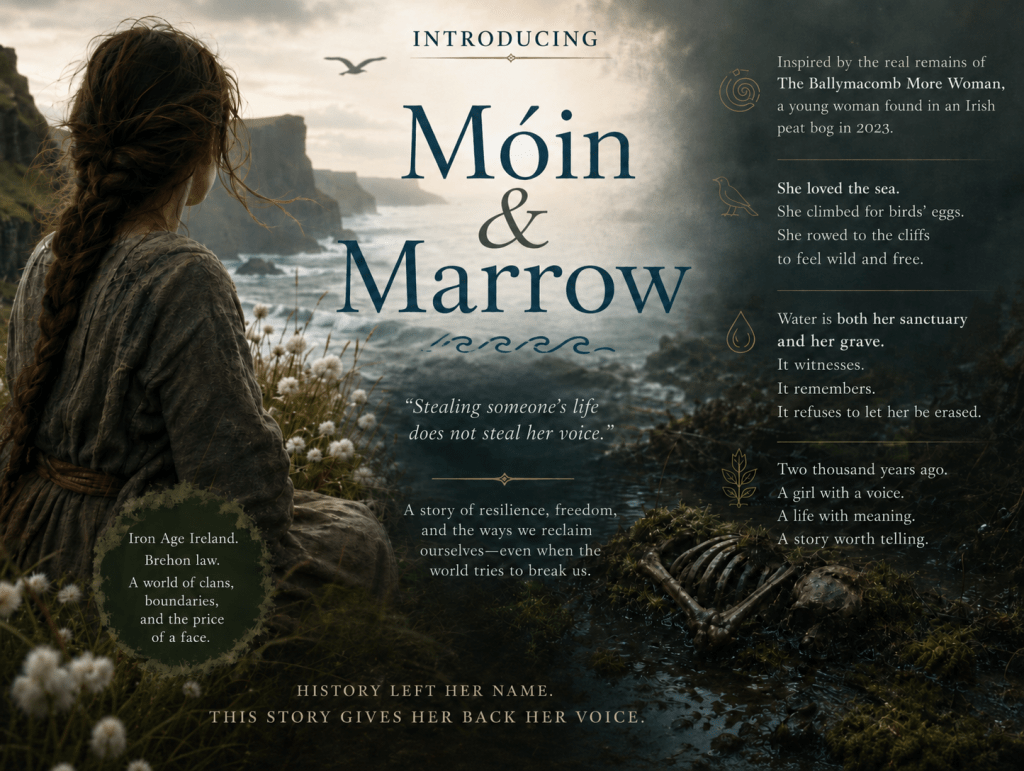
I usually take a few months “off” from writing when a new book is published. It allows me time to support the new book as it becomes available everywhere and it allows new characters to move into my head and introduce themselves to me. Echoes was published July 3 (aka: this month), but I knew almost immediately the setting of the next story and the name of the main character. The “story map” (aka: outline) is up-to-date, character sketches have been completed and research, while still on-going, is full. The new section on the website, under Móin & Marrow has a lot of the details on her home, her world, her name, but I thought it might be fun to delve deeper.
What is the title of the story? Any background on the title?
The working title is Móin & Marrow. The story is based off real human remains that were found in the peat bogs of Ireland in 2023. I was at Dunluce Castle, about a half hour from where she would be found in April of that year; she would be discovered in October. During our trip, we saw much of the coastline – everything from Rock of Cashel to Dunluce to the Cliffs of Mohr to Dublin – and what stands out the most to me was the water. In the story, the main girl, Bréaca, loves making morning row to the cliffs. She climbs them seeking birds’ eggs. It is the place where she feels the most free, the most wild, the most herself.
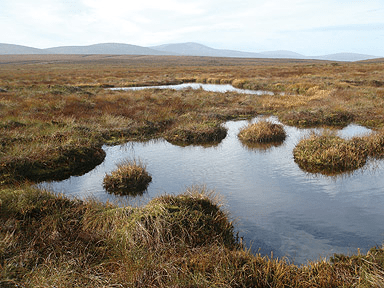
Peat bogs cover a lot of Ireland – about one fifth. They are waterlogged wetlands. The human remains of the woman my character is fashioned after would be found, then, in a moss-covered wetland. So, water is both the place she dreams of and also the place where she would meet a violent death and her bones preserved for two thousand years.
Also–her name, Bréaca, is pronounced BRAY-KA. Which reminds me of waves breaking. Or bones.
Whose remains are we talking about?
We do not know her name: researchers have dubbed her The Ballymacomb More Woman .
We do not know why she died or the circumstances surrounding her death. What we do know is:
- She was between 17 and 22 years old.
- She was tall – five feet, six inches.
- Plant fiber was found below her knees.
- Her neck was cut.
- She was decapitated and her head was never found.
- Finding her is significant because most of the peat bog bodies are male.
My story imagines her life–and how she came about such a violent ending.
So the story is about ritualistic killing?
No.
One theory about how the Ballymacomb More Woman ended up dead is that it might have been a sacrificial killing. This is the current theory because of other bodies in the area found. However, no one knows for certain. At its core, my story is about domestic violence. It would be near impossible to prove two-thousand-year-old bone injuries were the result of domestic violence. It would also be hard to disprove it. Moreover, whether this specific woman was murdered as a result of routine violence or not isn’t really the point: the point is that domestic violence has been around for at least two thousand years–and women are still killed today as a result of it.
What is the story about then?
Bréaca is a young girl who lives in a small village during Ireland’s Iron Age. She is wild; she is strong; she loves the sea and the white heads of the bog cotton; she is capable–and she lives under the Brehon law. Under this system, everyone had a “face price” that determined how much their word mattered. Marriages aren’t primarily love matches: they are strategic arrangements meant to advance clans. Bréaca’s parents aren’t cruel: they are realistic as they try to teach their daughter how to survive in a harsh world.
The story opens when Bréaca is young and we are introduced to a world rich with possibility. Harvesting eggs, sneaking out at night to play among the “bouncy grounds,” developing friendships and testing boundaries. When she is given to Éogan in marriage, she doesn’t worry or protest the union. But Éogan is on a mission: prove his worth as a man by acquiring something of worth. Everything you’ve got was given to you – this is Éogan’s cage. When his wife refuses to stop looking at birds or sneaking out at night, when her body cannot give him the son he craves, he becomes consumed with anger.
And Bréaca learns to gauge the weather by his jaw. When a tragedy results in a vicious act of brutality, she decides that surviving is not the same as living and sets out on a final pilgrimage to reclaim her voice and her freedom.
Is Bréaca meant to be the Ballymacomb More Woman?
No. The idea was sparked by the remains of the Ballymacomb More Woman and the story is set in the same geographical location as she lived but Bréaca is her own story. The remains found in the bog belonged to a real woman who had a real story. Unfortunately, we may never know what that was. What we do know, though, is that a young woman was murdered and decapitated. Someone tried to erase her… and, yet, it was her bones that were preserved for two thousand years while we know absolutely nothing about her murderer. The Way of Water lives in that space by arguing that stealing someone’s life does not steal her voice.
If we know the ending – that she is murdered – how can there be a hopeful ending?
Hope isn’t always life. In Whisperroot, Ainela redefined the word freedom at the end and found hope by dying on her own terms. In River’s Rowan, hope was found in solidarity. Éogan can stop Bréaca’s body, but he cannot retrieve every seed, control where they travel, or prevent the bog from keeping the record of what he tried to erase.
If she runs, but dies in the end, does that mean Bréaca failed?
I revert back to the central premise of this story: surviving is not the same thing as living. In order for death to mean she failed, the ultimate goal must be breath. But Móin & Marrow argues that that is not the ultimate goal. There are many, many people who are functionally frozen: they breathe in and out, go to work, pick up the kids from school, do the things life says they should but who are also operating from within a defense mode. They describe being a “shell” of themselves or saying things like they’ve lost who they were before trauma.
Historically speaking, there are many examples of people who died before achieving what might have looked like success to the world at the time of their death: everyone from Martin Luther King, Jr to Mindi Kassotis whose Navy Judge Advocate General (JAG) officer killed and dismembered her. She remained unidentified after her remains were found for five months. She lives on through her family and her body spoke over the lies her husband fed to prosecutors and her family.
Defining success for Bréaca does not mean: is she alive or dead at the end of this book?
Defining success for Bréaca means answering these questions:
did she find the part of herself she’d lost, even if only for a brief time?
did she reclaim her right to make independent choices, fully aware of their potential consequences?
did her story matter? Did it linger in the air, change the landscape?
In Móin & Marrow success is determined not by a pulse but by the heartbeat of her life.
Was Brehon law historically true to Iron Age Ireland?
Iron Age Ireland two thousand years ago left no written account of life that we know of. The earliest records are from Brehon. It’s not meant to be an exact representation of life in the Iron Age, but it is the closest thing I was able to find to apply loosely to her village. The same is true for the names chosen.
Does the village know about the abuse?
Some likely do. Some don’t. Some will accept explanations because disbelief is more convenient. Some will care but decide they cannot afford the consequences of helping. Just as with domestic violence today, sometimes people see what they want to see. It doesn’t mean that the village as a whole is evil. It doesn’t mean that everyone who knows is evil. It means that complicity has a cost.
Your work often includes a lot of symbols. What are some symbols and themes we might expect here?
I’ve written the prologue , developed the world and the story map is up to date. However, my maps are intentionally completed one section at a time. In other words, if the book is designed to hold three sections, each of 10 chapters, then I complete the story map for only the first ten chapters. Once I am around, say, chapter seven or eight, I’ll start working on the map for section two. This gives me more flexibility to allow the characters to develop as they will – in Echoes, the witches, for example, were never originally meant to have their own voice. The Long Night was supposed to just be a small background story. But mid-way through section I, I realized I wanted more from Kekena and I wanted to see the witches in action in a way that neither Maikel nor Soryelle could show me. This is how they earned their own voice. I have numerous examples of symbols in books that I never set out to be a symbol. So I won’t know the full answer to this until I’m deep into the story.
But, as for themes, I always start a book with questions that shape the characters and the plot. For example, in this one, I wondered what does it cost to be free? and what keeps us living when we’ve hit rock bottom? What gets us up when we have no reason to?
You mentioned the Witches’ voices. In Whisperroot, the town and the forest were both characters with distinctive voices. Is there a collective voice in this one?
Yes.
One of my favorite authors is William Faulkner; one of my favorite short stories is A Rose For Emily. In that story, he uses the collective voice to characterize the town. I’ve wanted to do something similar ever since I read that book – my story Ash characterizes Death but it was the only instance where I’ve tried to mimic that. Until Whisperroot.
It is so much fun I continued it with the Witches in Echoes.
And water is the collective voice in Móin & Marrow.
Since you’re early in the writing process, is there something that you’re worried about or that doesn’t sit well with you right now?
I take an unflinching look at abuse in nearly all of my books. I’ve covered everything from the Holocaust to Rwanda genocide to Romania’s orphanages behind the Iron Curtain. Child abuse has been examined relentlessly. I have a genuine and passionate desire to speak to survivors – I am a guardian ad litem, an advocate who works with RAINN and on the board of a nonprofit dedicated to assisting children in dependency care. I host workshops designed specifically for survivors and their loved ones. So, I’m not afraid of writing about domestic violence.
But.
In almost every book I’ve written, I’ve given the survivor a real lifeline. In Echoes, Soryelle had Maikel. In Whisperroot, Ainela had Zosia. In River’s Rowan, Sage had the other girls. In The Character, Anna had writing. In Mountains of Hope, Alyx had the soldiers. In The Storyteller, Daphne had Cole. Nearly every character who has survived the unsurvivable has had a definitive way out. Bréaca does not. There isn’t one thing or one person who will consistently be there for her or who is capable of witnessing her. This makes me antsy and a little discontented because it means the only person she can truly rely on is herself. Not only does this make survival harder but it also hurts deep because I’ve spent my life looking for evidence that kindness exists alongside evil. It’s been a thread that has kept me going when I’ve struggled the most. It makes the idea feel incomplete.
Is it incomplete?
Bréaca says no. And it is her story.
Conversely, what is something you’re excited about in the story?
The atmosphere. I’m more comfortable around mountains; she lives on the coast. I’m looking forward to building the Ireland world and exploring terrain that is different than some of my other work. I’m mostly looking forward to seeing what kind of relationships develop and what Bréaca learns about herself. Finally, I’m looking forward to her time alone – I’ve got aways to go before that since it’s the last section, but I’m looking forward to seeing her recognize herself again.
When is this expected to reach publication?
Early 2027. But reader can follow the tide here to check progress and read samples.

