Harvesting Air
Two thousand years ago, a girl lived in the bogland of Ireland. Today, we know her as the Ballymacombs Moore Woman. Her remains were found in 2023 and they tell us only a few things about her: she was young, between 17 and 22, and she met a violent death in the peat bog: her neck was cut and she was decapitated. She lived in pre-historic time–there are no written records.
Móin & Marrow is my next story imagining her life and what might have mattered to her. In my story, Bréaca marries at sixteen and endures domestic violence. Irish records do not go that far back but if we take the oldest documents and reason backwards, we find that this society was likely generous to women: they could hold land. They could ask for a divorce. They could bring grievances for harm. But such requests or accusations would have only been enforced if her tribe backed her. For a woman whose face price (legitimate thing) was lower than her husband’s, this would have been a mountain to climb.
This piece may or may not be part of the actual book (I have no idea because I’m still researching and an outline is still nonexistent), but it was the way she introduced herself to me.
I am already fascinated by her. I hope you will be too.
___
I am Bréaca.
My mother says the name is old, older than any of us and that that fits me because I’ve always seen things others miss. She says my father named me this because I was born in the space between day and night and the first time he saw me an unbroken beam of light passed through the open door of our home to shine on my face. Dappled sunlight, he says, is the language of the gods. My grandmother says I ought to fear it: if it was dappled light that your father saw on you, that means that beam sat beside dark spots; your name don’t know whether it’s light or dark. She finds my explorations tiresome. Once, I wandered off. Took the trail behind the village well and kept walking. I wasn’t fully weaned yet, so I’ve only heard this from the village, but they say it took them two days to find me and, when they did, I was ankle deep in the wetland picking bog cotton. No one ever asks me what I think of my name but I’ll tell you.
Water draws me. The others don’t like harvesting the sea bird’s eggs, but I do because it takes me to the cliffs. Four summers ago, after I first bled, my father allowed me to travel alone to gather them. Morning is my favorite time of day–the air is soft and cool–almost as though it’s a promise of something. The river is cold against my ankles when I climb into the boat. The current downstream is slow and steady. The row to the cliffs takes the morning and, by the time I arrive, I feel … alive. The wind picks up as I get closer to the cliffs; they rise up like mountains. The birds nest on the highest ledges. The eggs are pointed at one end, and I’ve always thought they looked like small spears. All my life I’ve had a nightmare where the eggs roll off the ledges and crash against the rocks below. The thing that saves them is the pointed edge acting like a dagger in stone. Climbing after these eggs makes my breath shallow and my arms burn.
We’re going to find that girl buried in water one day, that’s what my grandmother says, shaking her head when I return home with these eggs.
She was born to take risks. Let her be, my father insists.
The scratches I’ve gotten from those cliffs tell a story about my body: it’s made to bruise.
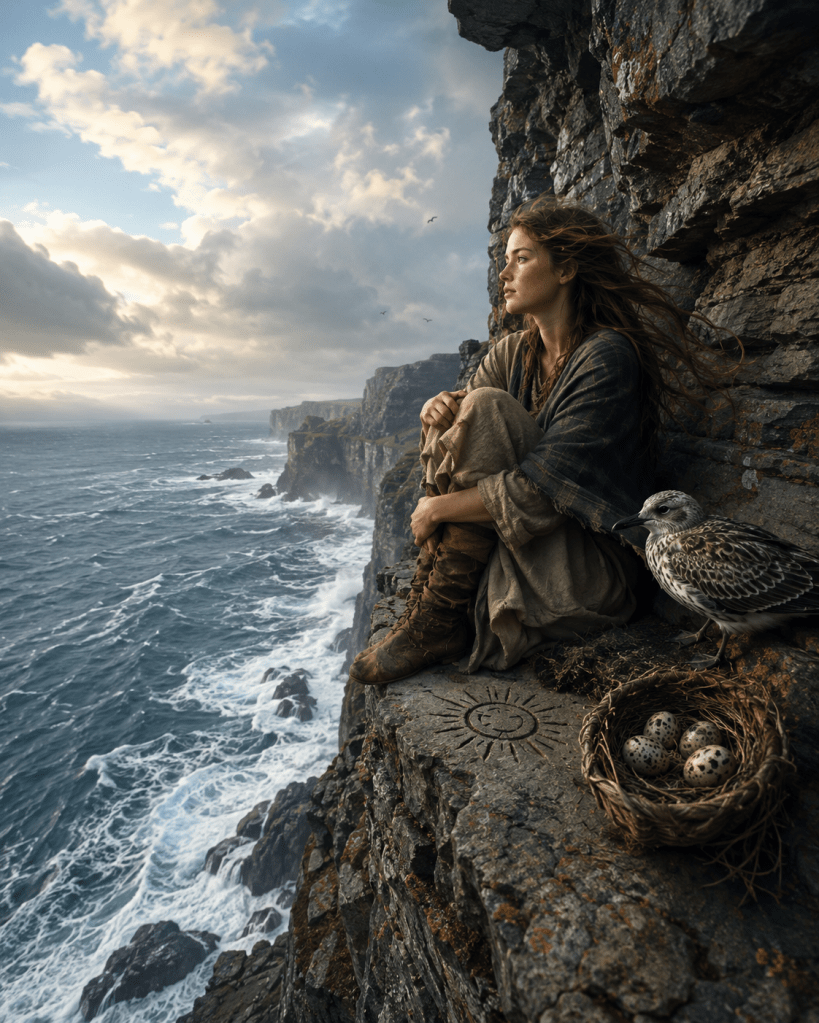
The climbing makes me hungry… but not for food. Once I have the eggs, I creep my way back down the cliffs with the ocean roaring in my ears. There’s a ledge halfway to the bottom that I’ve named Bréaca’s. Two summers ago, I found a sharp little rock and carved my name–a sun with rays–into the stone. It’s small enough that only I can sit there–well, and a bird, like the speckled one with the beady eyes who landed near me the other day and only left when I told him he could not have the eggs I worked so hard for. But, if I bend my long legs and curl into my knees, I fit well.
And the view.
When I think of my name–Bréaca–I see this view. The one of the waves crashing onto the rocks below me. From that high, the sky looks almost reachable. There’s a smell to the ocean, something like salt but also something else, something harder to name. Tangy, almost like the bog cotton. The ocean isn’t calm. It isn’t pretty in the same way that the bog at home is. But it holds me. With the rocky shoreline and the cliffs rising up so high, it feels as though I’m surrounded by everything I need. Sitting there, I’m cradled by stone; stone that has ledges to hide me, ledges for me to rest. In front of me is the sea–endless, deep, and strong. Its waves crash against the rocks and white foam bubbles in a line that stretches as far as I can see. Between the ocean and the cliffs, I am surrounded by strength.
The air is different on the cliffs, my mother understands. She’s not really harvesting the eggs; she’s harvesting air.
I used to pretend that if I could fill my lungs with enough of the wildness, then I might become the wildness. The funny thing is that, when I tell others that, they don’t hear me. My father says children are wild; you are not a child. The man I marry in two days’ time promises marriage will keep me safe, marriage will tame me. They see wild as dangerous. To me, wild is the sea bird who nests on the stone, trusting the egg’s pointed shape is the protection it needs. It nests on the highest ledge, the one that’s most visible, not because it’s dangerous to the egg but because it’s dangerous to anything that might threaten the egg. Wild is the ocean crashing against the shoreline and then pulling away from it. It knows just how far is far enough without anyone needing to tell it. Sometimes I sit on that ledge and shout my name – “Bréaca!” The ledge isn’t as high as the bird’s nest, but it’s high enough that my shout gets swallowed by the ocean’s roar. When I climb down, I pretend it means I am part of this place now. Maybe I’ve swallowed a bit of its wildness.
I smile as I carry that thought home.


[…] written the prologue , developed the world and the story map is up to date. However, my maps are intentionally completed […]
[…] Harvesting Air […]