Storymere

This is a deeply personal post, and some of it might be troubling.
If so, please know The Holding Room has many resources – some that you can download and print for free and some with phone numbers and website links where you can speak to people who will be there whenever you need someone to listen. Also, you can reach out to me by email here or here.
You are not alone.
I don’t remember a time when stories have not been part of my life.
The very earliest one I remember captivating me was Rapunzel, the original version. The poor peasant husband who stole rhubarb for his pregnant wife, the witch who wanted a baby but was so scared of being alone that she trapped the girl in a tower, the prince blinded by thorns he fell into after her hair was cut – the entire story felt lived in and real. It was the first story I remember falling in love with. But, by then, stories were already filling my head and spilling into real life.
By the time I remember repeatedly asking for anyone to tell me Rapunzel’s story, I was writing my own. Sweet Shelby and Stacy were the earliest ones – I don’t remember writing Stacy, the story of the little girl trying to find a present for her mother, but I do remember writing Sweet Shelby when I was barely in kindergarten.
Almost always, though, my characters appeared somewhere else before they made it onto paper.
Five is a pivotal age: many children start school then; adults can sometimes remember events from five onward. It’s also the year the sexual abuse began. I don’t know exactly when Storymere appeared; I only know I don’t remember a time without it.
I have a vivid memory of being maybe seven or eight and on a bed with a scratchy, wool-like blanket I picked at. I don’t remember the moments before or immediately after the abuse – I have frustrating snippets, words that sometimes trigger me, phrases that snag a corner deep inside – but I do remember with crystal clarity when his fingers gripped my arm, pulling it to touch him. If you’ve ever watched a pot of water on a stove, you’ve seen boiling bubbles. They start small– only a few here in the corner, and then a few more there in the center–but they multiply and grow in size quickly until they are rolling. Boiling bubbles is what my insides felt like whenever I was touched. Just as if some of that boiling water splashed on your hand, making you blister before jerking away, the boiling bubbles crowded my lungs until all I felt was panic.
The kind of panic that makes you look desperately around for anything that might give necessary oxygen.
I remember not wanting to look at him. The smell of Marlboro cigarettes and the feel of a stubble were overwhelming and when he would tell me to be still, those boiling bubbles would quadruple, and I would stop breathing altogether because I knew what came next. I couldn’t move because I was held down but I could scan the room. I vividly remember a black and gold blanket that hung on the wall of a lion.
My eyes landed on the ceiling.
Like the image of my ceiling above, the plaster made small peaks.
Except…
It wasn’t plaster anymore.
Instead of the bumpy ridge of the ceiling, I saw verdant mountains.

When I think back to the earliest memories of this happening, the scenes were small. It didn’t take up the entire ceiling, only the small patch above me. But playing among the mountains were children I recognized. Which is weird, honestly, because I was only seven or eight – I had no understanding of how to describe a character’s physical appearance. But I recognized them as characters in the stories crowding my brain. Instead of popping and blistering my insides, the boiling panic bubbles shrunk; I could breathe. I don’t know which character it was, but it was a boy, older than me but not by much, with blonde hair who was chasing a girl near water. They were bending over the water, very still, very quiet until, suddenly, they both jumped. The boy fell face forward. His arms splashed the water.
A sharp, stabbing pain made the scene completely vanish, like a zipper being pulled closed over the ceiling. The boiling bubbles were back and my whole body felt as though it were on fire. The smell of his breath overwhelmed me but, mostly, terror. The moment of the rapes almost always ripped me away from the safe place I’d found, and I would struggle to breathe. I’d start crying, which would make him mad, and there was something about the repeated rocking that I couldn’t handle. I remember feeling as though I were dying because I could feel my body being torn.
And I’d start frantically looking at the ceiling. I’d stare as hard as I could at the plaster. Like you make shapes out of clouds, I’d scan that ceiling for something in it, terrified because the bubbles were crowding my lungs again and air was hard to find and my skin felt as though it were being peeled off.
There – it wasn’t a mountain peak; it was a small crack. I don’t know how, but I saw crystal blue water running from the it. My body was on fire, and I distinctly remember my throat hurting. So, I stared at that water until the crack got bigger and then – there they were – the same two kids who had been playing earlier. The bubbles shrunk; I can’t tell you exactly what he was doing anymore to me; when he spoke, it was garbled now. But I could breathe.
It was a frog. The boy had a frog in his hands. I couldn’t see what kind or how big, but I saw its slick green body.
Years later, when I had two daughters, we loved going to a place called Cheekwood Botanical Gardens. Here, they have a beautiful pond. Once, when my oldest was around ten, eleven, they would make trips around that pond, searching for frogs. I didn’t tell them to do that; they just did. And, when they caught one, my world froze. Not because it was an idyllic childhood moment, one snatched from an era they weren’t a part of, but because I remembered the boy and the girl from the ceiling when I was seven or eight.
Storymere never stopped coming for me.
In fact, it became bigger the older I got. The better I became at writing, and the more complex my written books became, the more elaborate Storymere got. It was also easier to find. By the time I was in middle school, I knew that if he turned me so that I couldn’t see the ceiling, all I had to do was pick a spot on the wall and stare at it. Soon, the world on the ceiling would start spilling onto the walls. I remember Ash once slid from the ceiling to the wall, which was now a giant hill; he was laughing. I am convinced today that the little blonde-haired boy I saw when I was seven or eight was a younger version of Ash.
I never had a name for it.
The world I’d go to whenever my body felt trapped or in pain it couldn’t survive never had a name.
But, as I grew older, I would start deliberately trying to see my characters. I learned that staring at the same space for five, ten seconds could sometimes open doors or walls or ceilings. Air vents became caves or tunnels. Lightbulbs became the moon or the sun or Victorian-era lanterns. Fire alarms became bushes or stumps. Once, one became a bonfire around which my characters sat.
Most of the time, I never directly participated in any of the scenes.
But, occasionally, right as the pain was becoming so great it threatened to collapse everything, Landon spoke up loudly, saying, “Tiffini, look!” and pointing toward the most beautiful horse I’d ever seen. The horse was running – and I could feel my body shaking, I could feel the pain, but I could also feel wind on my skin that was really a fan blowing but it made me uncertain. I wasn’t sure if the jolting I felt in my body from what my dad was doing wasn’t just a galloping horse shaking the ground instead. It was enough to keep me there, with the mountains and the characters I loved, instead of being violently tossed back into rape.
I am currently writing Móin & Marrow; I hope to have it finished by January.
And I have never written two books at once.
Never.
But a week or so ago, a different character began shadowing me. Uncharacteristically, I knew within a day or so the overarching theme of her story, which meant I knew for certain she’s not part of Móin & Marrow.
She was seeing a world open on a primitive looking ceiling.
So, I did what I do and started cataloging everything she showed me.
And then I heard Landon, one of my favorite male characters, and he said, “Come ‘mere.”
There’s a few characters – Landon Montgomery, Clayton Cunningham, Maikel, Ash – who I would follow just about anywhere. Landon’s “come ‘mere” felt connected to Malika, the character who had been shadowing me. Soon, I knew “Storymere” was my world, the one I’ve seen all my life. The one where headlights shining through the windows become lighting bugs, the air kicking on is the roar of a nearby waterfall, and ceilings are entire geographical landscapes.
Thus came the name for Malika: Storymere.
The Research
It’s taken me nearly a week to flesh out her story and it is wildly ambitious.
It covers really important themes like post-abolitionist slavery in Mauritania, a country in North West Africa. Mauritania formally abolished slavery November 9, 1981 (one year after my birth) but that law did not define slavery as a criminal offense. It also did not establish penalties and had very little enforcement. Slavery was not specifically criminalized until 2007 (the year my youngest daughter was born). Amnesty International, as well as multiple other sources, widely recognize Mauritania as the last country in the world to abolish and criminalize slavery. Only in 2015 (one year before my 10-year-old niece was born) was that law further strengthened so that slavery was considered a crime against humanity.
But also…the further I began digging into Mauritania, I found pretty terrifying things that I’ve been meaning to write about but haven’t had the character to do it.
In 2001, 71% of Mauritanian women have undergone FGM – female genital mutilation. In 2015, FGM is about 68% according to UNICEF. By 2021, national FGM prevalence is about 65% for girls ages 15-49, 45% of girls ages 0-14. But, in Malika’s area of Gorgol, it’s 82% the same year.
The next part is a little eerie.
I knew Malika’s name before I started researching, reading books, pretty much tearing about UNICEF and WIPO and Human Rights Watch sites and videos. She was always Malika because Malika means “queen” and this girl has zero autonomy over her body; I wanted to talk about that.
But in my research, I found a UN-backed research / social innovation project in Mauritania that was specifically designed to end FGM. The name of this project? MALIKA
(Measuring and
Analyzing
Linkage between
Information Technology
Knowledge and
Advocacy with adolescent to end FGM).
The name for this 2018 project was chosen because MALIKA means queen (which was why I chose it for my character).
The implications for a story on slavery and who owns people spills into a conversation about who owns bodies. Because 82% of women in Gorgol have undergone some level of FGM (most of them fall into Type II).
Let’s move a layer down.
My story has two protagonists – one is named Aïssata. She is born in 1886. There is a raid, she is captured and sold to a Beydane family. She becomes the great-grandmother to my modern protagonist, Malika, whose story is centered in 2002.
In 2002, this was a country where slavery has technically been abolished for twenty-one years but has not been criminalized. So, many people are legally not “slaves” but are practically still bound to their former “owners” for economic reasons. Malika can honestly hear someone tell her, We’re not slaves anymore and yet still live under extraordinary former-master control. 7 in 10 women nationally (and an unbelievable 4 out of 5 in Gorgol) have undergone FGM.
Oh, but wait because that’s not all.
Zina is the Islamic legal term for sex outside marriage. It can include things like adultery or just having sex unmarried. Zina assumes unlawful consensual sex. Pregnancy is often considered evidence of sex and therefore it is also considered evidence of zina, not rape.
In 1983 (I was 3 years old), Articles 307 make zina a crime and the punishment is 100 public lashes and one year in prison. There is also Article 309, which was done in 1984 that criminalizes rape.
In 2002 (the year of Storymere), UNFPA released a report that says almost all women and girls who reported rape were accused of fornication and ended up in jail.
HRW states that even as late as 2018, zina is a problem. Survivors risk prosecution if they report sexual violence.
In 2016 there was a case of a fifteen-year-old girl who was gang raped. She reported the assault and she was prosecuted for zina. She eventually spent time in a women’s prison. “Zeina” was 16; she was trafficked into Mauritania at 14, repeatedly raped and became pregnant. She was convicted after giving birth of zina and she was required to report to the police weekly. M’barka was 17 in 2005. According to the SOS Escalves and US State Department, she was forced into domestic servitude, raped and impregnated by a household member and charged zina. Nothing happened to the rapist. In 2017 alone there were 64 women and girls who were detained in the women’s prison – half of them were prosecuted or convicted of zina. HRW also found that at least two girls housed in the juvenile center between 2015-2018 were charged with zina.
Storymere
Imagine being a young girl whose body has been cut before you can remember but whose entire life is shadowed by that cutting. Imagine it doesn’t heal properly, so you have thickened scarring that impacts your life. Frequent infections like UTIs. Menstruation is hard. Sex, even marital, loving and consensual sex, is painful. You’re shadowed by a pretty constant reminder that you are not valued as you are. Imagine being the same girl whose great-grandmother was a slave, owned by a Beydane (higher caste) family; a hundred years later, you don’t speak the same Pulaar language as your great-grandmother because you’ve been assimilated into the Beydane culture. While you are legally free, you cannot leave because the house you sleep in, the farm your father cultivates, the goats that feed you are all controlled by the descendants of your great-grandmother’s master. If you get sick, the Beydane family may pay for a doctor. If you get married, they may send a gift. If your family doesn’t have the resources to get a goat, the Beydane family may advance you a goat.
Now imagine that, at fifteen, you are raped by a member of that Beydane family; let’s say it was a son around twenty-years-old. He has social standing, wealth, and the respect of the community. You are a descendant of a slave, and everyone knows which families have been slaves, and which have been masters. Your grandmother and mother and father refer to the son’s father as “Sidi Mahmoud.” Sidi is used for nobility… or masters.
But it’s an interesting time to be alive because there are four midwives who have started trying to combat rape and FGM. Eventually two of the four would quit because they were scared of retaliation against their daughters. But, for now, let’s say there’s four of them. One of them is particularly influential and when she sees you, she slowly talks you into reporting the rape. Against the Beydane boy.
The Beydane family says, How could you be so ungrateful? We have always taken care of you. Your family says, We’ve worked the land ourselves and the response is, yes, because we’ve let you. Eventually, they come one day quietly and say, “The house has been given to someone else.” It’s their house, not yours. The goats are theirs, too, not yours. So, now one fifteen-year-old pregnant daughter is in jail for zina and the rest of the family is sleeping literally outside with no access to the cultivate the land and no goats.
Where do you go?
I would go to Storymere.
There’s a place not everyone can go.
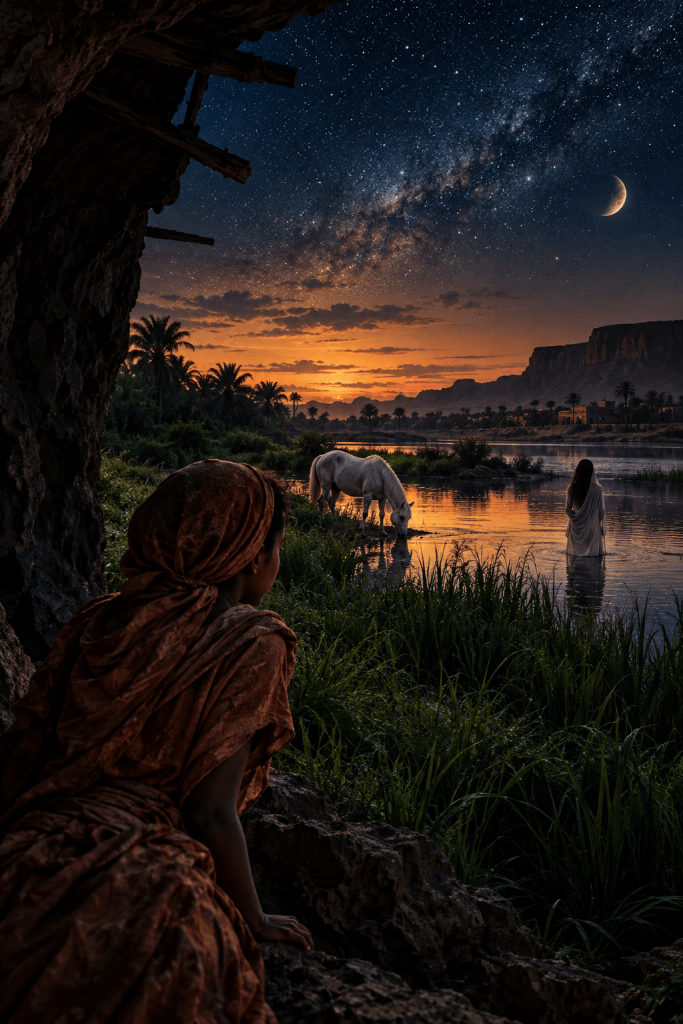
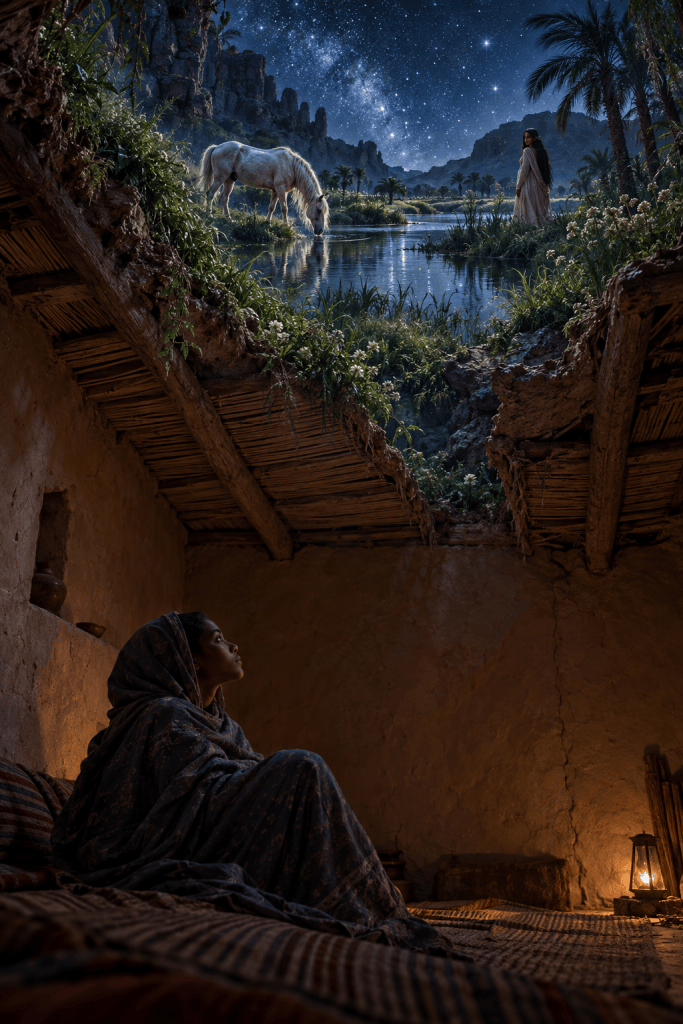
It’s a place with thick green grass, a million stars, and the most beautiful horse whose mane smells of the wildflowers a girl who loves him braids through it. It’s a place where the mere is wider and deeper than it is at home, where caves sometimes begin as the dark gap between two of the roof beams above my bed, where the reed matting sags. Its borders are made of men’s hands and terror-filled screams.
Storymere isn’t on a map; I don’t know how to tell you to get there. The language isn’t Hassaniya; it’s not even the Qur’anic Arabic we use when we pray. It’s something different, something much older. Something that sounds like my Lalla’s song, the one with the melody that reminds me of the crested lark’s lonely but beautiful cry.
Yahya.
He’s the son of Sidi Mahmoud. His family used to own mine. They do still control the house we sleep in, the land Dada works, and the goats that feed us. The village loves Yahya: he saved a woman’s life, gave others grain when the harvest failed, and repaired a roof damaged by a storm. Once, when I was small, he let me ride his horse.
When he threw me down, I tore, bled, and panicked because he opened an old wound. The pain was such it ripped me from Storymere. I’m only fifteen; I’ve never known a man, but now they say my body is evidence of sin. Aminetou says there’s a word for what he did: rape. She says I should speak because we’re not slaves anymore.
Or are we?
Lalla, Mama, and Dada say I cannot speak. They say, “It would take only one word from Sidi Mahmoud, and we would lose everything.“
I don’t know who or what to believe. I miss the sound of fish splashing in the water in Storymere. If I could stay there, I could be safe. I’ve started visiting more and more; I’m not afraid there.
Except for the woman. She is always near the water. Sometimes walking. Sometimes sitting with her hands folded in her lap. I have watched her for years. I thought she belonged only to me; I thought I made all of them.
Until the night I described her to Lalla.
Lalla stopped singing and said, “Where did you see Awa?”


[…] written dissociation in many books. But never about dissociation. Storymere is quite literally how I survived childhood rape. Now, I knew three things: Malika was my […]