What the Author Gives
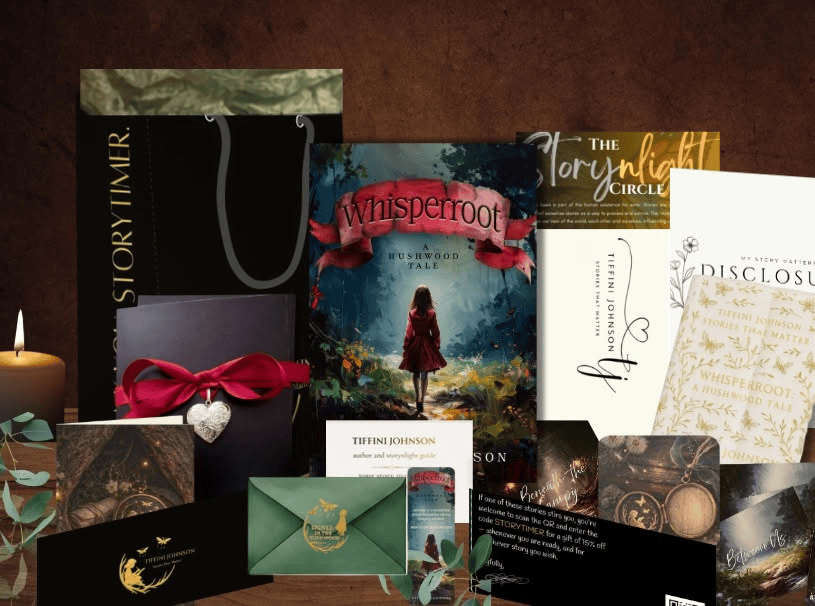
I am gearing up for a local event where I’ll greet people and maybe sign a few books. It’s a chance for me to meet some of the Storytimers from Chapter Chats. Mostly, it’s a way to form connections with others. In March of this year, I did a bookstore signing for Whisperroot: A Hushwood Tale. I hired a photographer to help me capture the event because it was well-promoted (radio, social media, print, etc) and it was a great turn out. In preparing for this smaller event, I thought I’d share what I offer those who come to a signing or event. Sometimes authors refer to swag – but, for me, what I’m trying to accomplish goes far beyond marketing.
It truly is about connection.
And these bags have led to some of the truest, emotional and lifechanging conversations I’ve had with readers. Other writers have asked me about the bags. There isn’t a right or wrong way for writers to meet people. Many provide bookmarks and that’s it and that’s completely beautiful because it allows the focus to remain on the story. For me, personally, my stories are often very raw and close to me. Sometimes, they are so close they make me feel exposed. Opening up conversation to include others helps me feel ready to meet anyone where they are.
The Back Story
My writing is not “light” reading. My daughters tell me it’s time to write a comedy (Alight: “It can be a dark comedy.”) Stackhouse, who does his upmost to avoid serious conversations but who, for some reason, read the entire book, said, “Even if you had noted that the sun shone brightly, it would have been dimmed by what was going on.”
I know it takes a lot to get through one of my stories – even if you have not survived abuse. If you have, well, it can be next level challenge.
But I also remember.
I remember sitting through the training in downtown Nashville to volunteer with the local Rape Crisis Hotline. That cop that came said things that I thought no one had ever experienced but me. I mean, I knew people had been raped – that’s why I was in the room. But he showed images – graphic images – of survivors at the hospital undergoing a rape kit. And he said: “Rape is defined in TN by unwanted penetration with any object.” As he said that, he showed pictures of weapons that had been used against women in Nashville.
And my whole self cracked.
Nauseas, I left the room to the bathroom, where I threw up and sobbed. The ants I sometimes felt in my skin were back and I was very close to a breaking point. I had no idea how I was going to sit through the rest of that training. Shame felt unbearable. It felt like someone was pulling back a curtain and looking in on what happened with me and my dad.
I begged God to hold my hand through the rest of that training. When it was over, I went out to my car, in a ghetto-ish part of town, and sobbed. A cop knocked on my window and told me it was not safe for me to sit outside and I should go home.
I was deeply moved.
But, despite how triggered I was… there was also an underlying whisper I couldn’t shake: Someone went through what I did. There were images. Proof that it happened to someone other than me. It wasn’t just the words being said, it was seeing that the violence and the physical damage that I thought proved I was never going to be normal.
See, the rawness, the graphic-ness, the ugliness of what that cop said and showed us was traumatizing, yes, but more than that, I found hope in it. Because it was inescapable proof that I was not alone. Someone else — and not just someone else but someone else IN NASHVILLE, my hometown — went through it too. Which meant somewhere out there was someone who might understand.
I was 18 years old, 2 years past his arrest.
Three years later, I’d tell my mom… and my writing would dramatically shift until I was sharing what I went through, what abuse felt like in my body. I didn’t stop the ugly words. I wrote scenes of child abuse and somewhere hidden in the back of my mind were those images that made me violently ashamed… and simultaneously hopeful. I wanted to find the woman that officer talked about. And I wanted her to know that I felt it too, that it happened to me, too.
No matter how different our stories — there were pieces that were the same.
…
So that’s the baseline, that’s the real purpose behind the scenes that people tell me repeatedly, “I can’t read that.” But if we can’t read it, then can we talk about it? No? Okay, so we’re just going to hide it – because not all survivors have the language to talk about it and some that do don’t want to. Because shame is powerful.
And so I write the things. I speak the things. But I don’t want to throw someone into that world unprepared and unsupported. I wish I had had someone in that bathroom with me at the training. I wish I had broken when I stayed after and the cop who presented smiled at me and said, “You’re awfully young to be doing this.” Instead, I smiled back, nodded, and told him thank you for sharing. The items I choose to give away are my attempt to provide a softer landing than I had, something to grasp hold of when you read some of the basement sections.
The Overall Bag / Contents
- A custom made shopping bag.
- Custom made tissue paper used to wrap the book / stuff the bag
- Custom printed stickers to seal envelopes
- Custom printed notecard that was tucked into the book. This was not seen right away; it was meant to be discovered
- Personalized Discussion Cards
- The book, of course.
- A journal
- Decorative ribbons and lockets
- A custom notecard on which I’ve written a handwritten letter to every person
- A bookmark
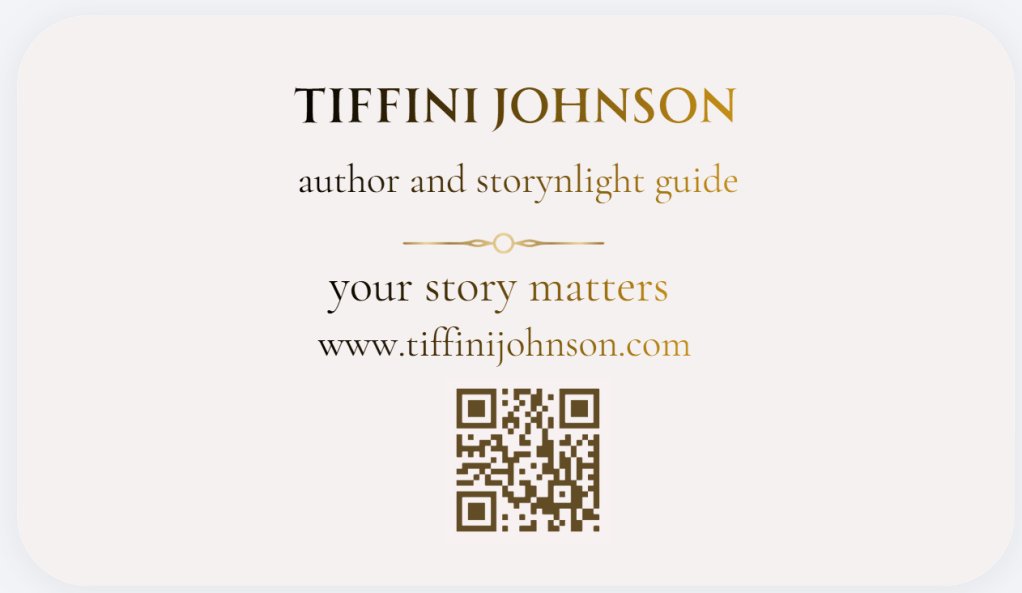
- My business card
- A professional photo sent to you after the event
- A small pouch with a few honeysuckle seeds inside
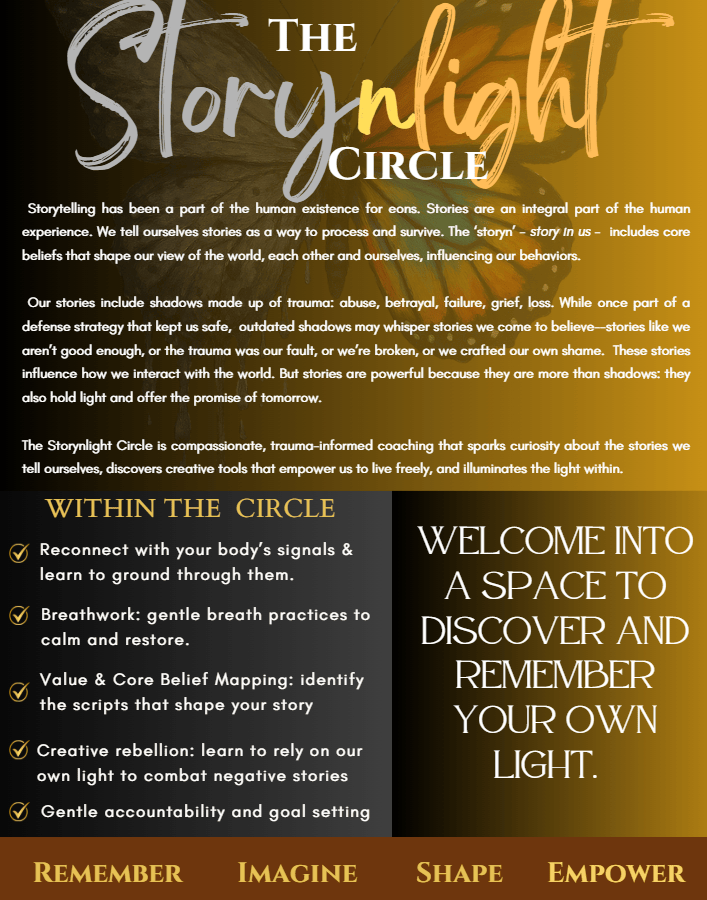
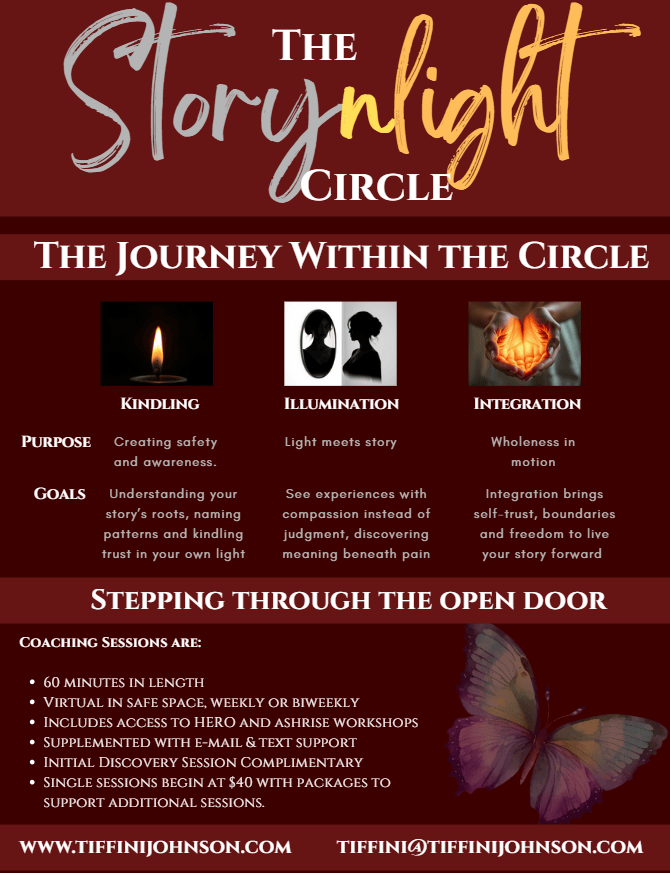
- A Storynlight Flyer
- A printed Disclosure Guide booklet (I have since added a Safety Guide that future events will receive)
- A printed catalog of my published work
- A one of a kind autographed fine art print of the cover art (there was only one of these – it was used as a giveaway)
Each of these items meant something important to me and/or to the story we were celebrating. Each book has its own ecosystem of giveaway items. In the discussion below, I’ve highlighted whether the item is “standard” (included regardless of the book being celebrated) or “varies” depending on the book.
I designed all of these myself through Canva but used various printing places to bring it to life.
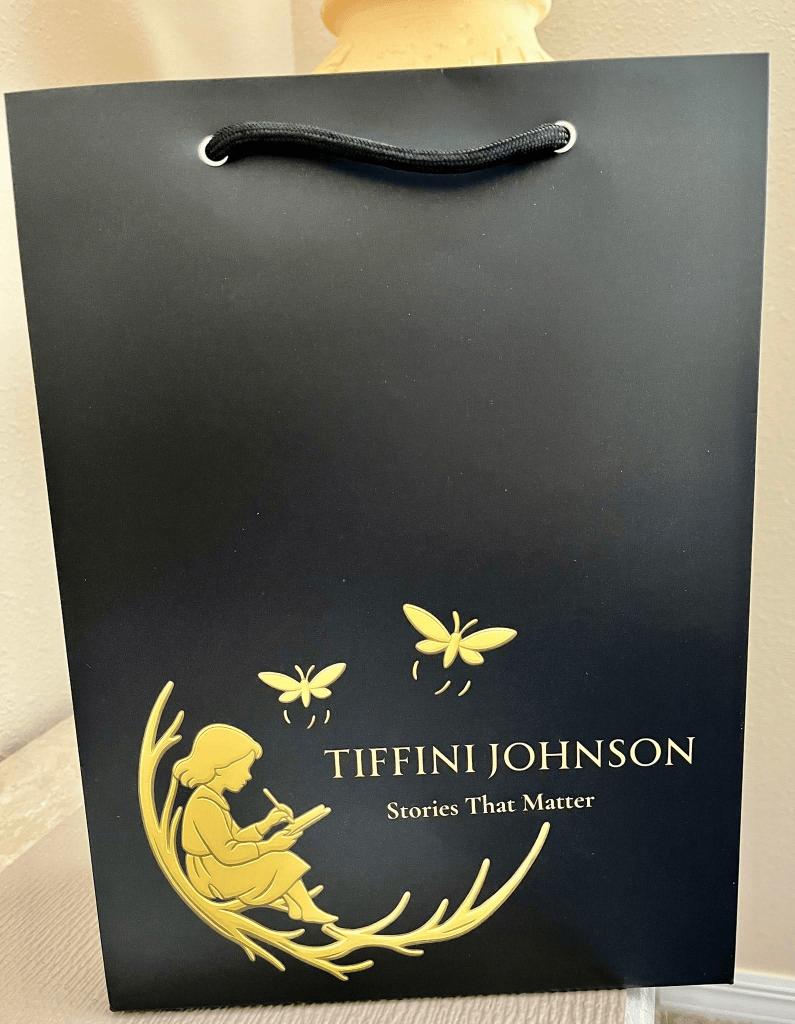
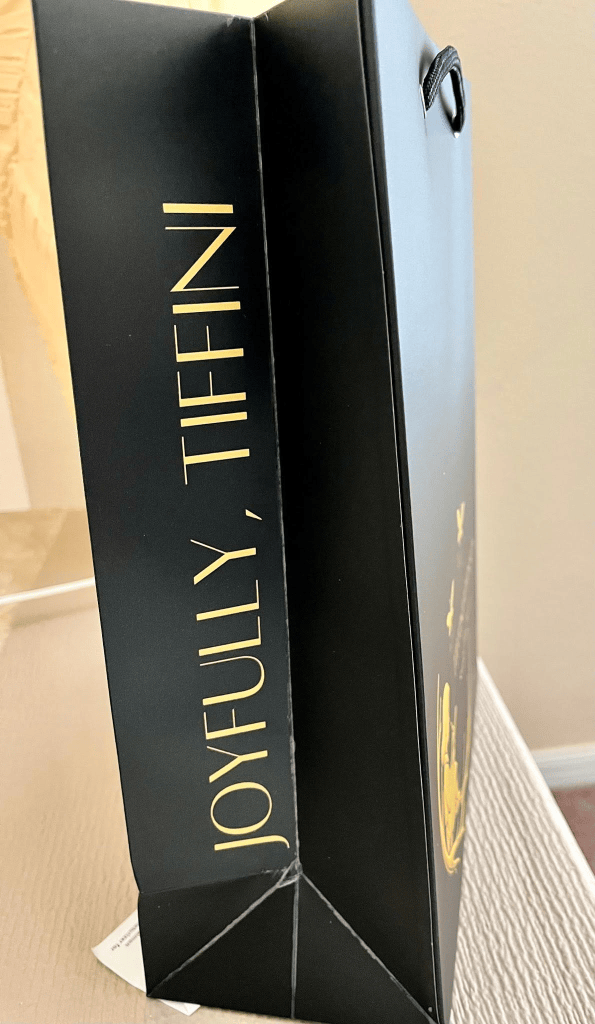
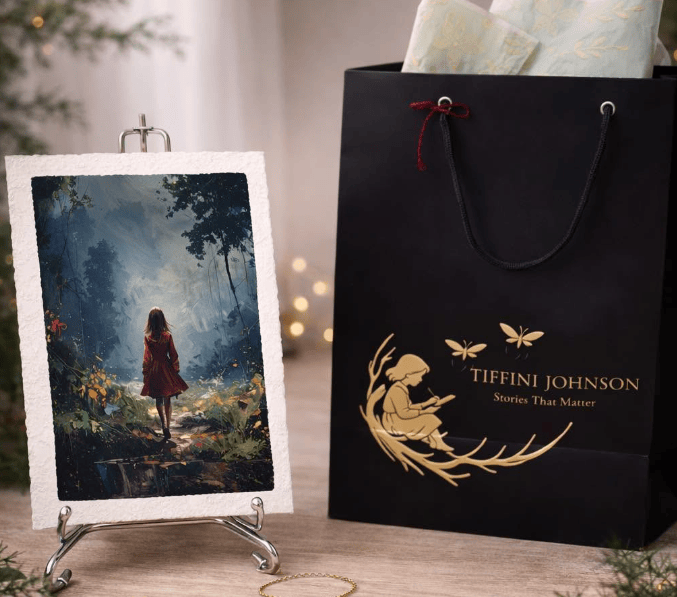
The bag
standard
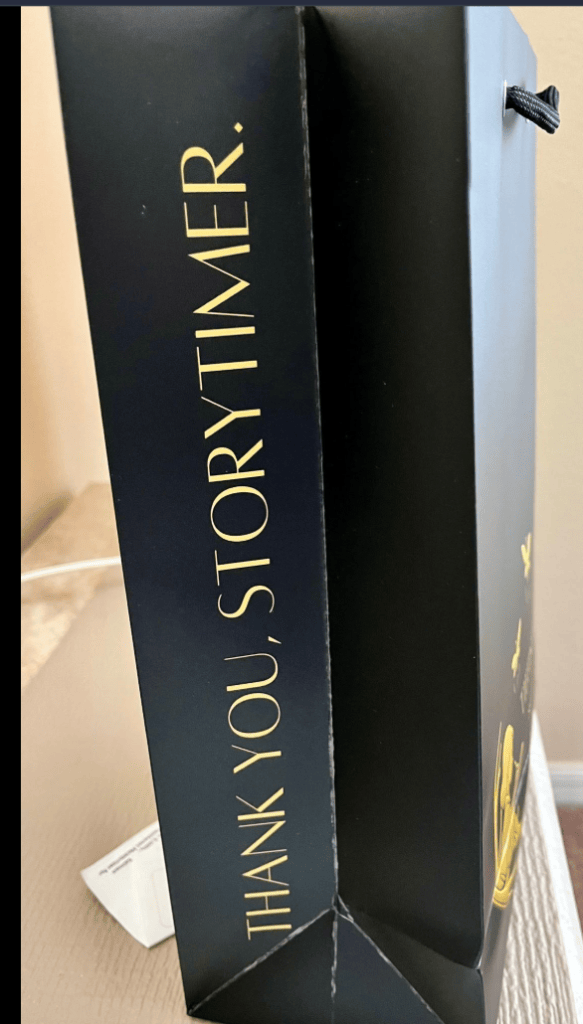
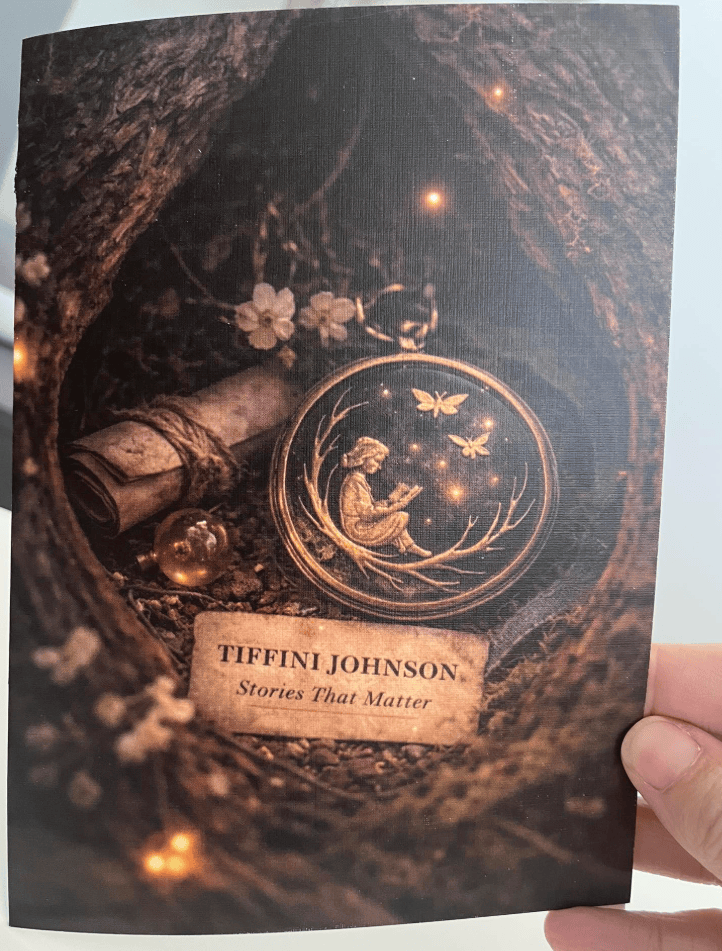
For practical reasons mostly: the giveaway bag holds all of the things I want readers to take home with them. I wanted them to also be personal. On front and back, the logo which is very personal. I’ve been writing since I was a little girl, I love trees, and butterflies are a symbol of transformation. On either side was a message: on one side was the message I mostly wanted to share, “Thank you, Storytimer” and, on the other side, was the signature I sign emails and books with: “Joyfully, Tiffini.”
I absolutely love these bags.
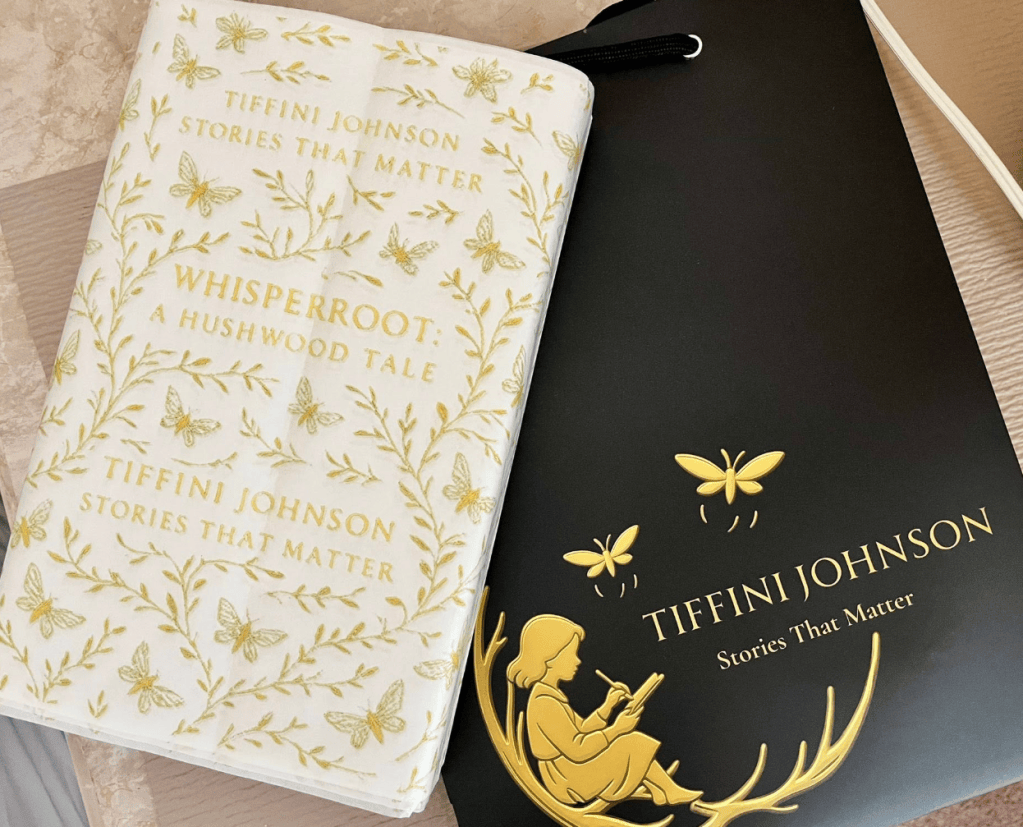
Custom designed and printed tissue paper
Varies by book
Healing from trauma, especially sexual and / or physical violence, is not a rip-off-the-bandaid kind of thing. It’s more of an uncovering of layers. For me, my early work was about just saying what happened. Learning to use the word without shame bringing me to my knees. Practically, I wanted tissue paper to line the bags. But, more importantly, I wanted it to symbolize uncovering. This is why the idea was to, once the book was autographed, wrap it in the paper before sliding it into the bag. This didn’t work quite as I had planned because I didn’t have enough time to set everything up before the event started. That said, I did end up using the paper to stuff the bags and loved it.
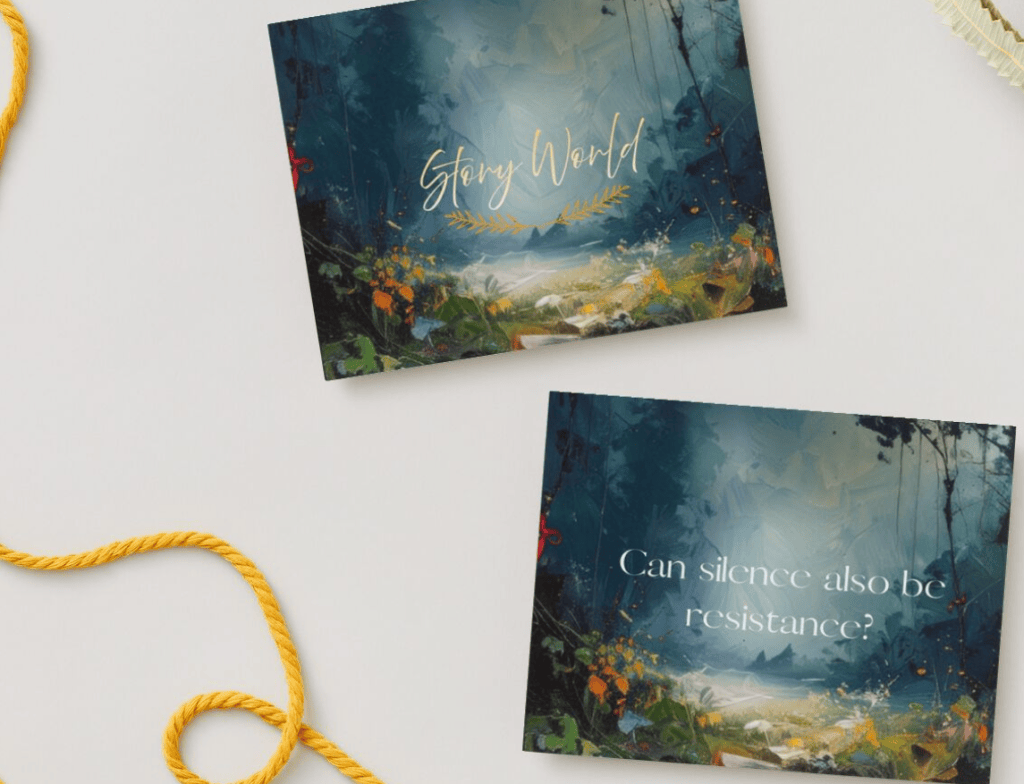
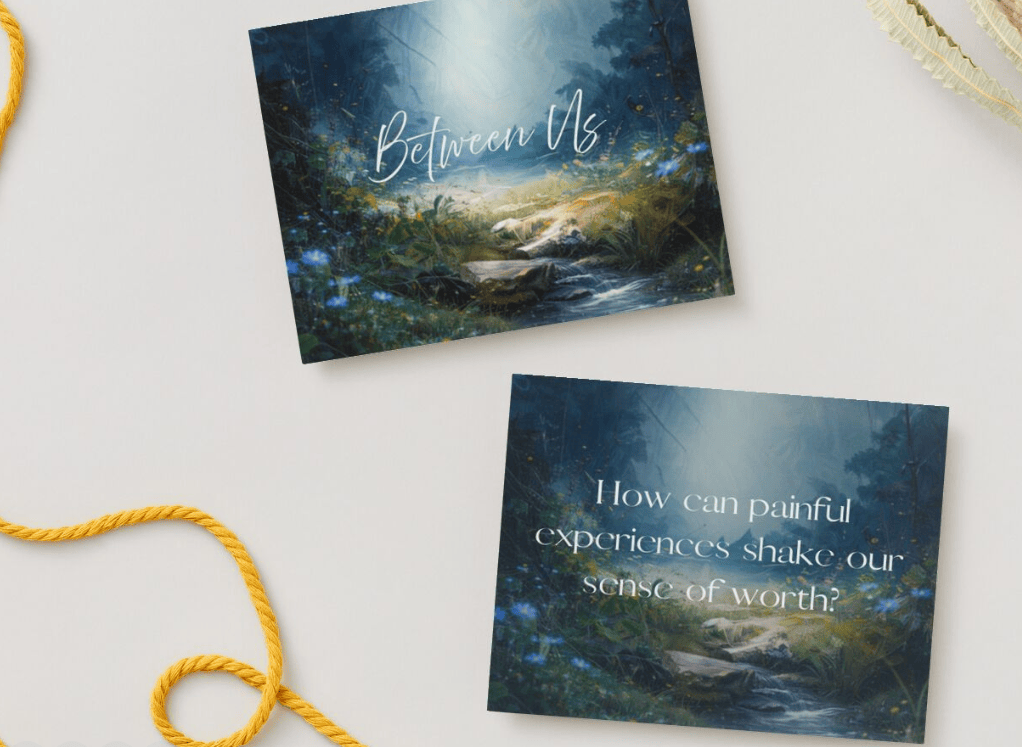
Personalized discussion cards
standard – but customized for each event
I’ve said it before and I’ll say it again: my primary goal is connection. I am not interested in just signing my name; I want to know you. If you come to one of my events, I am going to remember your face forever because you are quite literally proof that dreams come true. So, I want to take time to know something about you and what intrigues you about my stories.
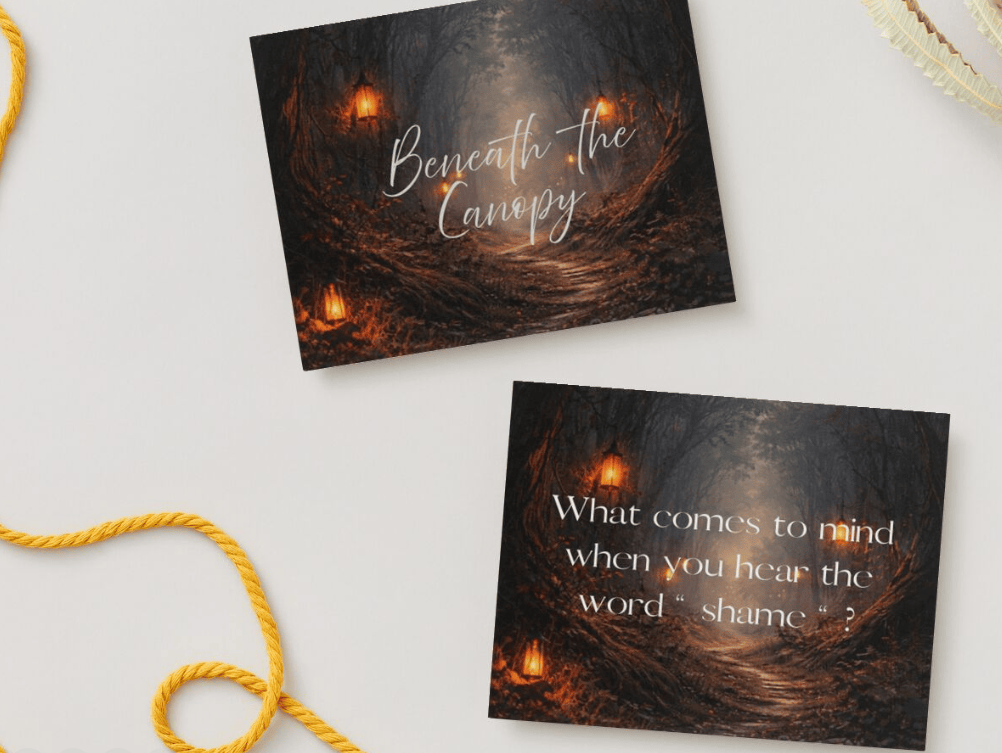
So, I created enough discussion cards for each person who RSVPed to the event (33) plus ten extra. The discussion prompts were divided into three categories: Story World, Between Us, and Beneath the Canopy. To make sure people participated in the discussion, I gave each person one card at random when they came into the bookstore. The cards were inside colored envelopes that corresponded to the category (green for Story World, blue for Between Us and red and Beneath the Canopy). During the discussion period, I asked who would like to read the question on their card for us to talk about – and I picked the colors strategically.
Green (Story World) questions were broad, more of your typical book-club type questions. Safe questions.
Blue (Between Us) were a little more personal; intended to take the discussion a little deeper.
Red (Beneath the Canopy) questions were the most personal ones, designed to dig even deeper.
It helps ensure that there is not just awkward silence when I ask the audience for questions. It also is a collaborative way to tell readers what kind of themes the book they will be buying from me has. Finally, it allows me to talk about the characters and the story without just lecturing at the audience – it’s a true conversation. Below is a sample of each category.
Bookmarks
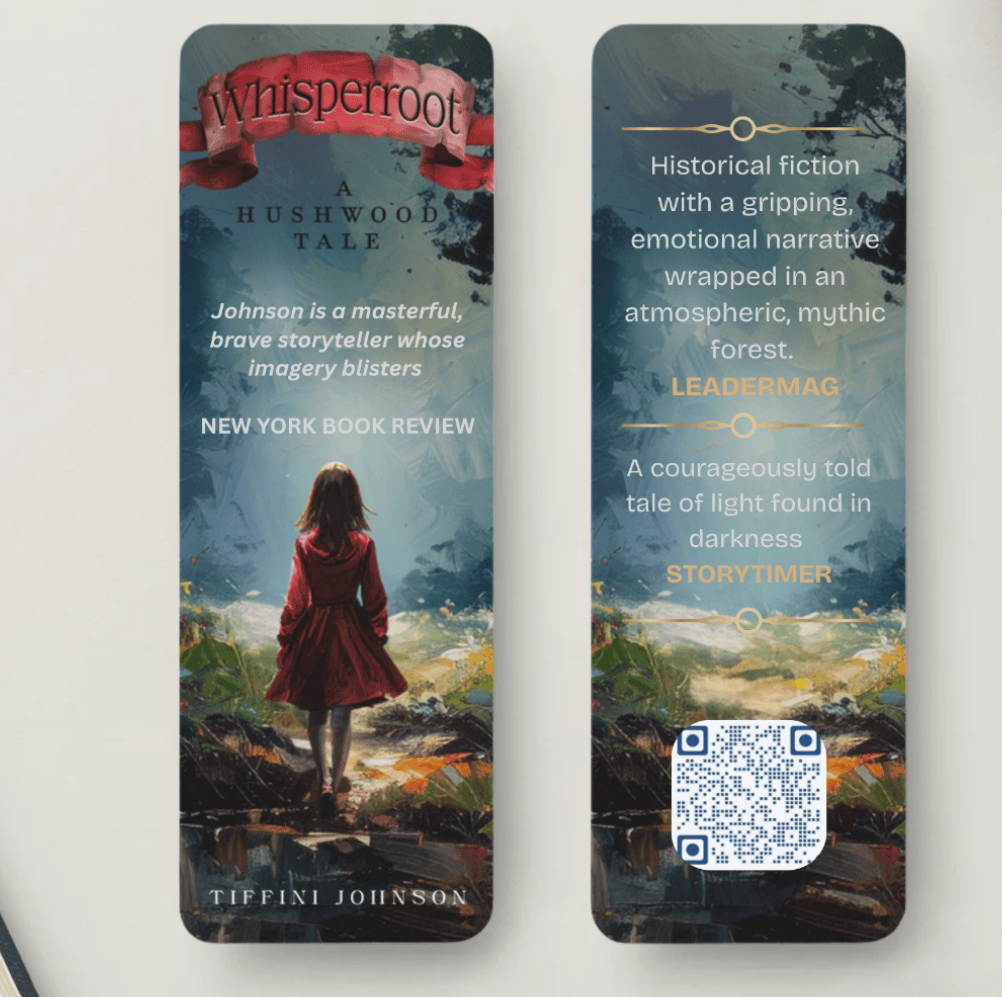
standard but customized for each book
Because sometimes we lose our place without someone holding it for us.
Blank Journals
standard
The idea is that you have a place to turn to when the book gets heavy and you need a place to vent. If you don’t have someone to listen—you still have an outlet.
Writing is oxygen to me; a journal was the best thing I could think of to offer for those moments where the story makes your brain feel on fire, but you can’t scream it out to someone. You can write it instead.
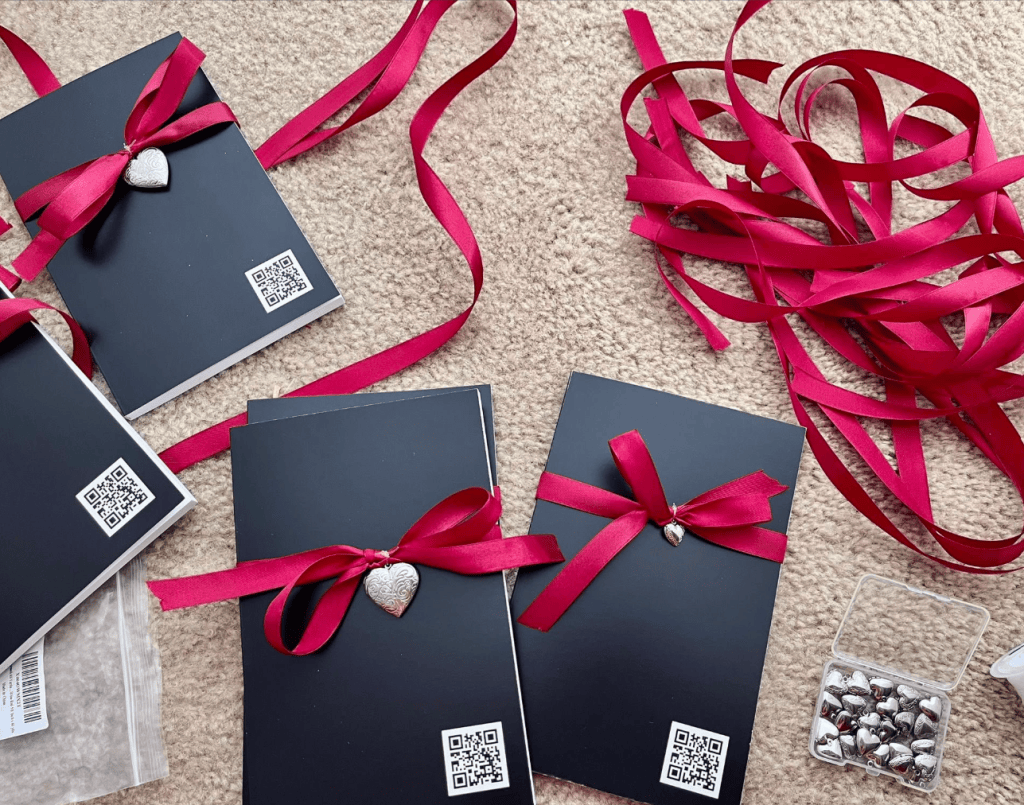
Because “Your story matters” isn’t just a tagline for me, I wholeheartedly believe it, and want to hear yours. That’s why the front cover is blank space except for a QR code. It’s blank because it’s not about me. The back of the journal is the logo of a little girl writing and saying “Your Story Matters.”
Ribbons & Lockets
varies by book
I hand tied these ribbons on all forty journals. I hand tied the lockets to each one. And, as I did so, I thought about each of the people who had RSVPed and why the journal might be significant for them. For Whisperroot, one of the recurring symbols was red ribbon. They symbolized several things including girlhood, loss of innocence, and memory. In the story, Zosia is given a locket by her sister Ainela. The locket becomes meaningful in the story. For me, personally, I grew up loving lockets and the idea of holding an image of someone beloved close to me. The objects vary based on the book I’m celebrating.
The Notecard
standard (but customized wording for each book)
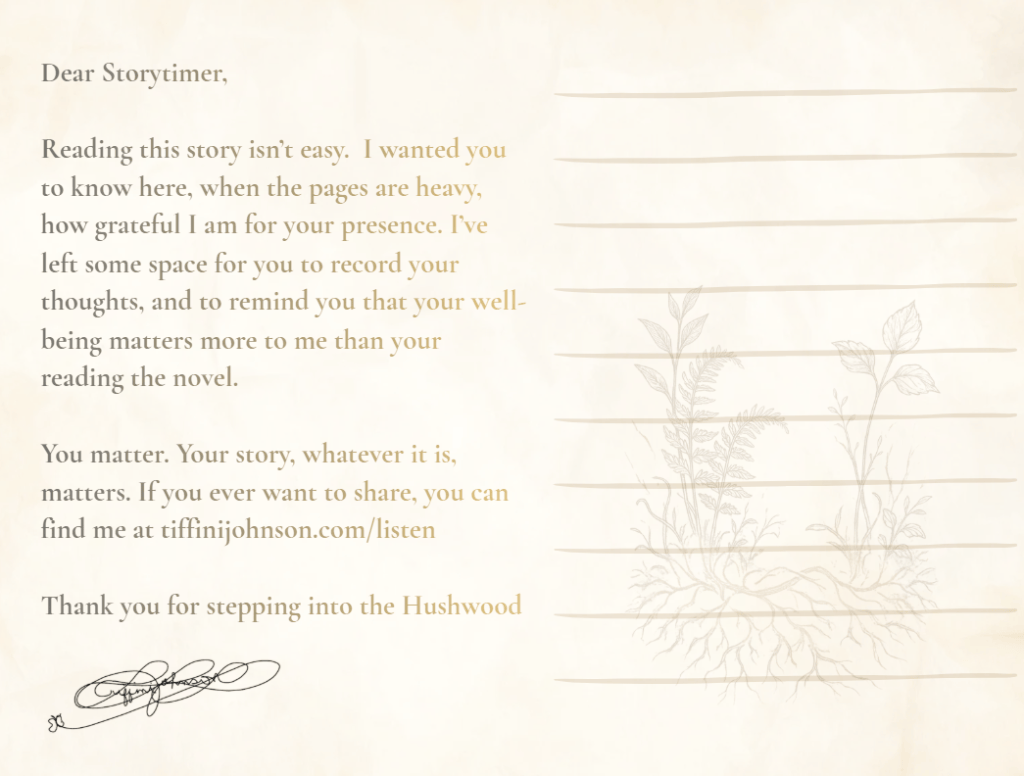
I wanted to make sure that the readers had somewhere to land specifically at the hardest chapter in the book. For Whisperroot, that is a chapter called “Unwritten.” So, this notecard (with space for writing on front and back) was tucked into the book at the start of the “Unwritten” chapter. It was meant to be discovered as they read the really, really hard things. Scenes of abuse. Scenes of dissociation. Scenes of wondering about death. I am not writing to be graphic just to be graphic – I’m writing because I truly believe that saying the ugly things can help someone believe she / he is not alone; that someone else thinks and has experienced the same thing. The notecard is because I’m also aware that my readers are not all in the same place of healing. Some may read those chapters and feel like I felt in the training for RSAC – seen. Others may read those same chapters and not be yet ready to confront them and it could trigger some big emotions. The reading letter at the start of every book, and the notecard is my attempt to say, if you’re not ready for this, it’s okay. Tell me what you’re going through today.
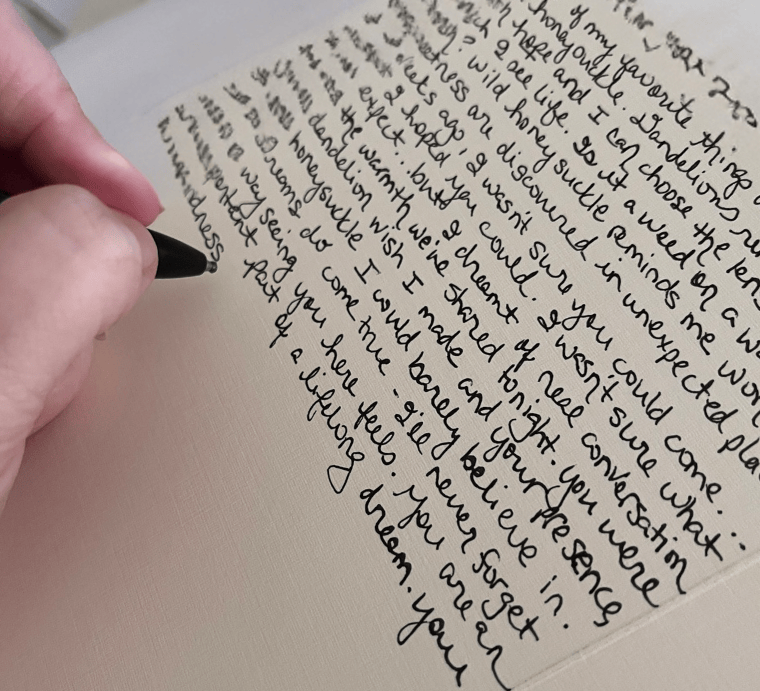
The handwritten letter – customized notecard
standard (letter is customized)
I handwrite a letter to everyone on really nice, thick notecards. For this event, that meant forty handwritten letters. Each letter took me fifteen minutes to write (because my handwriting is atrocious which means I have to write slow so that it can actually be deciphered)
The letter writing is something I’ve done since I was fourteen. I was a freshman in high school and my French teacher gave an assignment that said we had to teach someone French. Most of the class taught their mom or sibling or friend a couple of words. I went to the elementary school and asked a third grade teacher – Ms. Speck – if I could teach her class French one week. I fell in love hard with these kids and with teaching. And Ms. Speck asked if I would like to continue teaching her class every week for the rest of the year. I had to get special approval from the high school principal (who was like well yeah) to miss French class once a week in order to do this.
It was a pivotal thing in my life.
And, at the end of the year, I wrote each of those kids a hand-written short story and a personalized letter. The kids’ responses to the letters melted my heart. When I graduated high school, I volunteered with Junior Achievement and did the same thing – wrote letters and stories to every child. Individual ones. Personalized ones. I did it for the kids in every one of my Sunday School classes that I taught. And the responses have been unanimous over the last twenty-five or so years: a kid told me he was going to frame the letter, another asked his mother to read it to him every night, several have started crying and many ask if I can read it to them personally.
Handwritten letters have told them: you are seen. You are important. You matter. Which is what I am working so hard to do. And the people who take time to come to my events, to read challenging material… you are the realization of my dream come true. It is more important to me that you know I care and that I believe you have a story worth sharing than it is for you to buy my book. In fact, I’ll give you the book for free. What I want is for someone to walk away from encountering me or my stories and think, huh. Maybe I can do today.
The Disclosure & Safety Guides
standard
I print these into booklets because I want to make sure I try to support people who are trying to find words or a way out.
Maybe the story or the conversation made you think, “It’s time. I want to tell someone something that happened” but you don’t know how. As a RAINN specialist, I lead people through that every day. It’s a practical tool to help you outline how to share. And listen – if you’re not an abuse survivor, this still applies to you. Because we all have pain and we all have things that make us feel not so great about ourselves and that we might not have shared with anyone. The outline can be used to share ANY story.
Or maybe you’re in a healthy, good place and nothing is nagging at you… but you know someone who you think may be struggling. Perhaps this is a gift from you to them.
You can view the below or click the link to downloads below if you think they are helpful.
Pouch with honeysuckle seeds
standard
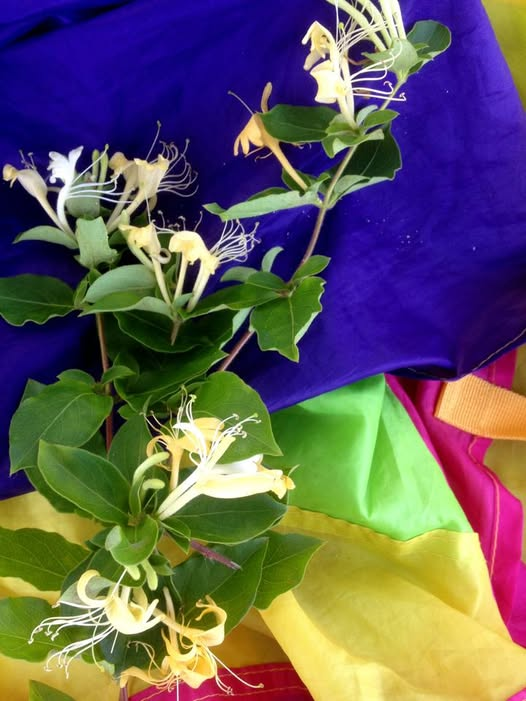
While the letter is always unique and customized, it usually talks about my love of honeysuckle. Honeysuckle grows wild … but it also has sweetness in it that you can taste. There might be someone who is struggling to find a reason to stay. The temptation to escape pain is real. Planting seeds isn’t only symbolic, it’s a physical act. That seed requires you to water it today… and it depends on you to water it tomorrow. And, if you do, one day, it’ll sprout and, on that day, a tiny bust of joy will catch you unawares.. because you helped something survive. Watering your honeysuckle vine could be somebody’s reason to stay.
Also because your presence at a book signing of mine — well, it was that drop of sweetness to me.
A gift certificate good towards another book
standard
Because money should never be a barrier to connection
My business card
standard
A two-sided, full color flyer for the Storynlight Circle
Because sometimes a handwritten letter or an email isn’t enough. Sometimes you need someone you can count on to answer consistently, someone with training, someone who can help give you practical tools on an on-going basis.
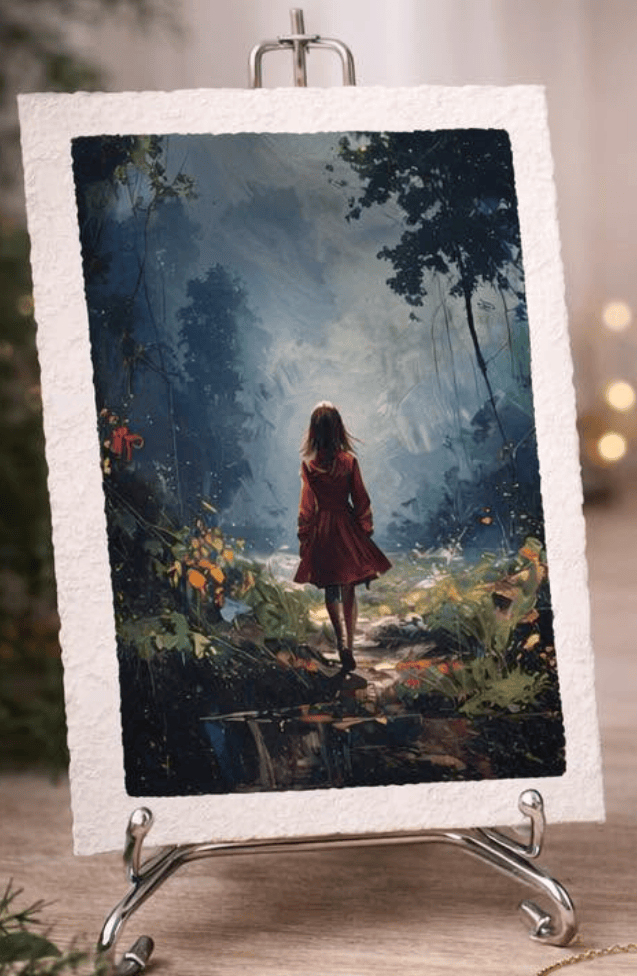
Autographed Fine Art Print
varies by book
I always have something special. Sometimes I use this something special as a giveaway – for this one, anyone who RSVPed to come to the signing had their name entered into a drawing. If you gave me your email address for the newsletter, then you had a second entry. And, in the month leading up to the event, I ran a fun social game: if you tagged someone, and that person RSVPed to come, then you got another entry.
For this event, the something special was a fine art print of the cover art. Because I am really proud of it and it’s gorgeous.
It’s a 10 x 15 piece of fine art on Torchon paper. I chose Torchon for three reasons.
1. It’s made of 100% cotton fibers. The reason this mattered to me is because rag paper ages slower than regular paper. A lot slower. It’s thicker and stronger… and it can last hundreds of years. Centuries, even.
In my life, my art, my writings, are more than just make believe stories. They hold pieces of my whole self… and part of the reason I write is because doing so is one of the main ways I can make sure my girls have something by which, one day, they can truly know who their mother was and why she mothered them the way she for.
I still sometimes fall asleep with the ink from a Bic pen seeping into my skin between my fingers. Stories have seeped into the marrow of my bones since I was old enough to hold a pencil. Having weightier, stronger paper that might withstand the test of time mattered personally.
But, in the story, WHISPERROOT, it goes deeper because it may only be fragments of the truth that survive. And when you are hurting—really, really hurting—sometimes the only way you can speak is in fragments. Broken shards of truth that seem incapable of organizing themselves into the way sentences ought to might burst free and make no sense to others…. But those fragmented words are pieces of your story that deserve weight and time and memory.
2. Torchon paper is textured. Up close it has ridges and grooves and I can’t wait for you to see this print in person because, when it catches light, it doesn’t just -reflect- it. Instead, it -absorbs- it. Its grain is not regular, its unpredictable so, instead of a smooth pattern, it soaks in all the color. Especially when the colors are so vibrant and so watercolor-y like this print is.
And the way that makes my heart pitter patter is kind of goose pimply awesome. Because, you see, it’s kind of like leaves pressed into soil… or how buried memories just sometimes won’t stay buried. No matter how many times I was hurt… no matter how many times I needed a reason to stay… no matter how deeply I thought I couldn’t go through one more thing…. There was a tiny piece of a little girl who simply couldn’t be destroyed. If we catch enough light, we can hold it. If we see the flicker of hope in a baby’s face or a stranger’s smile or a song on the radio… or, maybe, a book… maybe we can believe that tomorrow is more of a promise than it is a threat.
In the story, what the fragments of parchment hold is far more than words printed by ink.
Every time I tilt the artwork or pass it by a light, I am reminded that this is more than a dark story—it’s also a story of sisters and how we never really forget those we love. It’s a story about a girl named Ainela who somehow absorbed the tiny embers of what could be, of what might be, and kept breathing on them, tending to them, until they did exactly what this paper does: caught light.
3. Torchon is traditionally a watercolor paper. Which means it absorbs water; it holds color…. and then it allows the colors to spread slightly.
What if we all spread a lot of the light we absorb? But, conversely, whisperroots grow in the Hushwood. Whisperroots grow when a truth is buried. In the story they pulse with heat and shimmer faintly red. In real life, whisperroots are barriers: fear, shame, addictions, lies—anything that prevents us from being able to see that the person we used to be, before the harm, the one we grieve for, isn’t really gone.
Sometimes, instead of a giveaway, I have the something special tucked away and I give it to someone I think needs it or would appreciate it. Such was the case with this event. Sometimes there’s a conversation and you just know you are the reason I hosted this event. And my job in that moment is to be fully present and to let that person know you are seen. Having something that cost a little more and is a little more special allows me to do that.
I deliberately left my name and the book’s name off of the fine art design.
Because my hope is that the story is not just about me but that it helps you recognize something within you.
I did autograph it – in the white space at the bottom. 🙂
A professional photo of us
standard
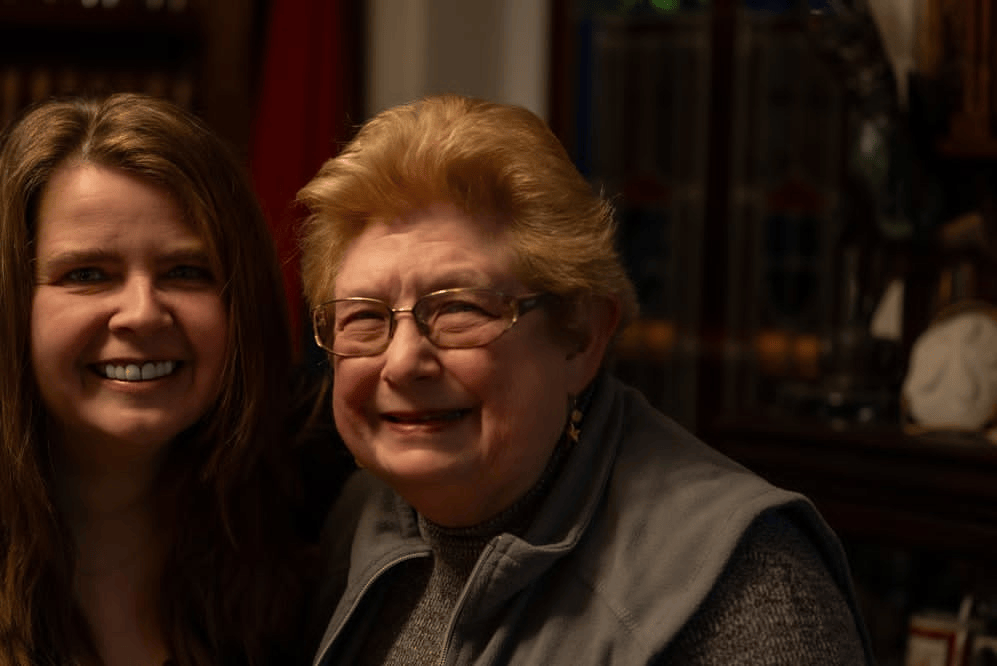
I hire a photographer to come and take photos of the event. The photographer takes a photo of me with you and I email you the photo when I receive it. It’s one less thing either of us has to worry about – who is going to take pictures – and it’s a thank you from me to you. I hope it also serves as a reminder for Storytimers of an intimate and meaningful connection built.
The Giveaway Bag
Literature has a way of changing perspectives and acting as a catalyst to bigger dreams.
The Holocaust: The History of the European Jews by Martin Gilbert, pretty much every book written by Ann M. Martin (The Baby-Sitter’s Club) during the eighties and nineties, Bridge to Terabithia, To Kill a Mockingbird, Black and Blue, The Things We Cannot Say – these were all pivotal books for me. They were escapes, yes, but they were also magical portals to a land rich in friendship and belonging.
My hope is that glimmers of these things come through as we share our stories.
 Tiffini Johnson