A Day in the Life of a Writer
I normally don’t write things like this.
Trauma is always quite high on my thoughts-list, especially since I am so active in RAINN and other volunteer areas. My daughters are also first in my mind. The stories I’m writing are there, too, but the shape of them usually winds up as a sample chapter or a “this chapter made me think of some deep rabbit hole we can go spiraling in together.
Not so tonight.
Over the last couple weeks, three very different characters have been living in my head: one from Moin and Marrow and two who were brand new, Aissata & Malika. Aissata is Malika’s great-grandmother, their stories are a century apart, and I’ve been quietly collecting a ton of research that I assumed wouldn’t be used until after I finished Moin & Marrow.
My characters are sneaky people, though.
And I am 100% character driven.
So, because I couldn’t get Storymere out of my head, I thought, okay, I’ll try it. Writing two books at the same time is something I’ve never even contemplated doing. Honestly, the thought itself exhausts me. My historical books aren’t just look up a few details and then use creative license. They are intense research that involves way more than reading a book or two. The cultural and historical context matters because that is how I build my worlds and immersive fiction is my happy place.
I wasn’t sure about this at all. But I have learned over 40 years to trust my characters.
So, here we are. One full week into writing two very heavy, very hard books.
I thought I’d share my process.
The Plan
- Six out of seven days spent actually writing.
- Monday-Wednesday with Moin & Marrow.
- Thursday: Chapter Chat email, editing whatever needs it, and a day to breathe before switching worlds.
- Friday-Sunday: Storymere
- Writing is divided into two blocks during the day – two hours very early in the morning and three hours very late in the evening. This allows me to break for “real life” and “real work” and motherhood and all the other things during the day. Crucially, it also allows me to start each day with my characters and gives me a break usually when I most need it.
- Writing is divided into two blocks during the day – two hours very early in the morning and three hours very late in the evening. This allows me to break for “real life” and “real work” and motherhood and all the other things during the day. Crucially, it also allows me to start each day with my characters and gives me a break usually when I most need it.
- Goals:
- 3,000 words per writing day / 9,000 words per book per week / 18,000 words total per week.
5 hours of writing per day - Exception: trauma chapters. Trauma chapters involve my history and sometimes leave me feeling frozen or very vulnerable. So, on days where there is a trauma chapter involved, the goal is to finish the trauma scene without emotionally collapsing.
- This exception was very important. Because I have a tendency to “push through.” I also have a thing about expectations. If I expect to do or achieve something, and I don’t, it can quickly spiral into a so then I failed loop which can paralyze me. Even though the 3,000 / wpd is an arbitrary number I created simply because I know that I typically write that per day, it feels like an expectation. So the exception gives me “permission” to slow down when I know I’ll need to.
- 3,000 words per writing day / 9,000 words per book per week / 18,000 words total per week.
Week One Reality:
Stats after six days of writing and one transition day
Móin & Marrow: 11,982 actual words / 9,000 expected words
Storymere: 10,988 actual words/ 9,000 expected words
Combined goal: 18,000 words
Combined actual: 22,970 words
Overage / Deficit: +4,970 words
In other words, I exceeded the goal for both books, finishing above target. The bigger win, for me, was that it didn’t feel like a race; it was pretty much my natural habitat.
When I write, my process is very structured.
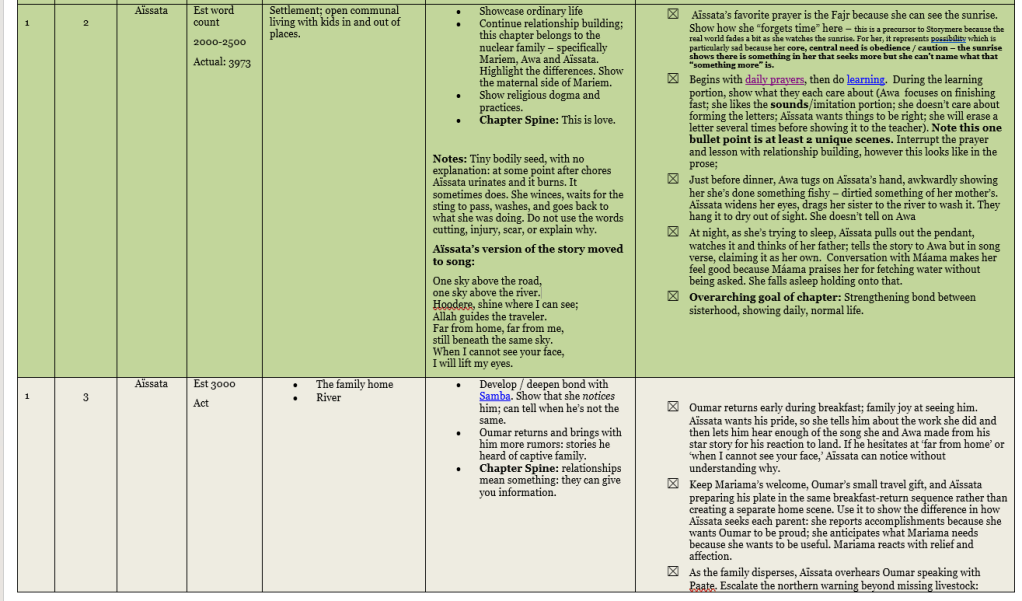
Before starting, I read over the chapter I’m either in or starting and the next chapter so that I know what’s coming up. Below is a sample of my outline for Storymere.
Writing 22,970 completed / revised / edited words in 6 days may be more or less than “real” authors; I have no idea. But, for me, it makes me feel like my characters are real, breathing people.
What was hard?
- I thought switching worlds would be hard. But because I deliberately included Thursday as an “off” day between books, it allowed me to ease into writing a different world. I also worried that they might “feel” the same but they don’t. I know what Awa will have for breakfast. I know Breaca values freedom enough to break rules; she’d be excited about the possibility of skipping school to race boats along the river whereas Aissata would rather a hole open up in the earth and swallow her whole than risk disappointing a single adult in her life. If Awa says, “I’m not hungry” — it is a red flag because that child is always sneaking groundnuts or dates or food. I eat, sleep and breathe their worlds which makes my writing hopefully feel alive.
- I think the hardest part is what’s always been the hardest part: scene breaks, the first word of the chapter. The first line of any of these is the hardest. Once I know how a scene opens, I’m good to go. But I can often stare at a blinking black line in Word and go, “I got nothing.”
A few things to note about the outline:
- I call outlines “story maps.”
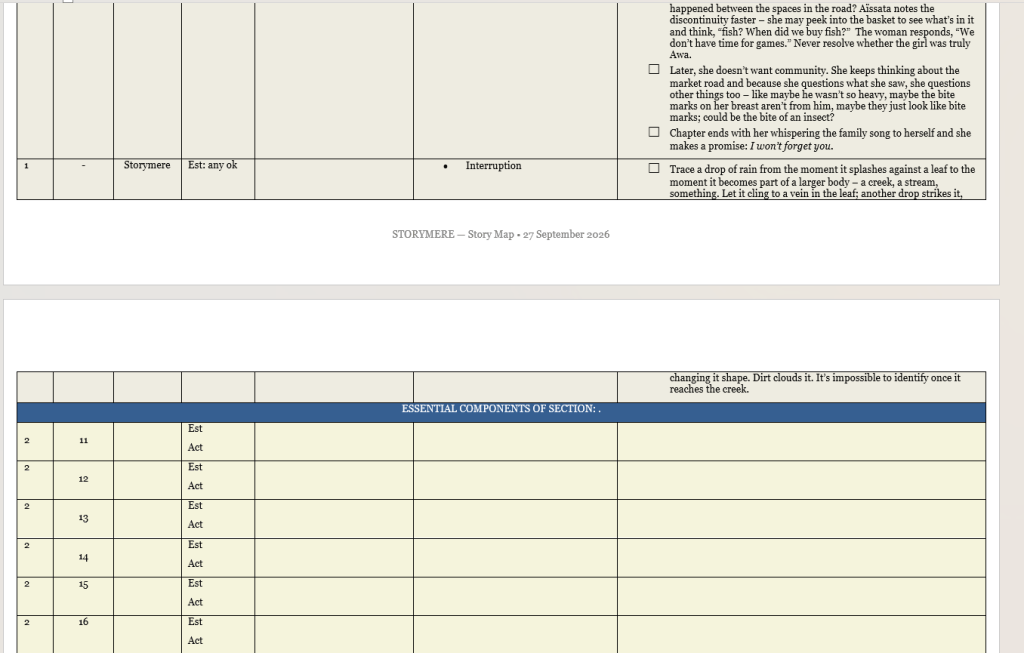
- Story Maps are not just outlines. The one for Storymere is 54 pages. It includes character sketches/summaries, all of my research broken out by topic, blurb/summary of the book, structure of the book. In the below, row one says this is section 1, chapter 2, with Aissata’s POV; estimated and actual word counts, setting for the chapter, key goals with the chapter and any notes I need to make the chapter work and then the beats that I want in the chapter. You can also see in the notes “Chapter Spine” – every beat in the chapter should work to achieve the spine’s goal. If it doesn’t, then I rethink the scene, add to it, delete from it, or move it. Links jump me to research that I will likely need to make certain scenes work. For instance, “daily prayers” links to a section in the story map that details Muslim prayer routines, phrases, times, practices, etc. In the second row, you can see Samba is a link: that jumps me to his character sketch.
Every section has a “blue box” that tells me what the ultimate goal or purpose of the section (as a whole) should be. It keeps rabbit trails to a minimum. Note the little comment box at the far right of the blue box. I use comments in word to expand an idea / important note that I need for myself but that I don’t want to dedicate actual space to. - I write scene by scene. And writing it does not mean ‘rough draft. ‘ I draft the scene. And then I go back over the scene with three line-level edits for grammatical, historical and continuity checks. This helps me ensure that the book is clean scene by scene while I’m in it. Only after the revisions, edits, line level and historical integrity checks do I call that chapter complete. The checkboxes are marked after the words are written and revised three times. The whole row is shaded green once the whole chapter is “complete.”
Revising / editing at the scene level as I write has helped my books be so much better because it’s current when I’m editing – I know what my intent was: was something a stylistic or deliberate choice, characterization? Or was it an error?
- Story Maps are not just outlines. The one for Storymere is 54 pages. It includes character sketches/summaries, all of my research broken out by topic, blurb/summary of the book, structure of the book. In the below, row one says this is section 1, chapter 2, with Aissata’s POV; estimated and actual word counts, setting for the chapter, key goals with the chapter and any notes I need to make the chapter work and then the beats that I want in the chapter. You can also see in the notes “Chapter Spine” – every beat in the chapter should work to achieve the spine’s goal. If it doesn’t, then I rethink the scene, add to it, delete from it, or move it. Links jump me to research that I will likely need to make certain scenes work. For instance, “daily prayers” links to a section in the story map that details Muslim prayer routines, phrases, times, practices, etc. In the second row, you can see Samba is a link: that jumps me to his character sketch.

Some questions others ask me:
Do you use AI?
- Anything that makes it into the book is the product of my brain and nothing else.
- I do not use AI to generate ideas or sentences that end up in any scene.
- My research methods. I love research and also it’s the way I make my books feel lived in. To research, I:
- Live in a few websites: WHO, U.S Department of Justice, JSTOR (it gives me scholarly articles/newspapers, etc), United Nations.
- Have a few specific journalists, like Nicholas Kristoff, whose work on human rights issues I admire greatly, that I hope and pray have written extensively about the time or place or issue I’m writing about.
- Use real people. For Taramul Viselor, I was able to speak to a caretaker who worked inside an institution. I also contacted the former President of a radio station to seek transcripts of actual radio broadcasts with dissenters. I also asked Romanian citizens to give me recipes, games, and feelings about their culture. For Remember the Nightingale, I interviewed a Hutu and a Tutsi about their experiences. I visited Auschwitz for books like Ash.
I use AI for:
1. I do ask AI to give me a list of primary sources on a topic, and book titles to kickstart my literary research. It will usually generate a handful of helpful ones.
2. I will sometimes use it for quick, solid answers like: “do squirrels live in Papua New Guinea?” or “what’s the Polish word for bowl?”
3. It is difficult for me to read geographical descriptions and picture it in my head. So, if you tell me, there are “mountains to the west and a river to the east with acacias.” I have a general idea, but it doesn’t tell me what the landscape LOOKS like. So, I take the details my traditional research has given me – like topographical details – and ask AI to generate maps. this helps me see the broad landscape. These images never make it into a book – they are helpful tools for me to understand the land.
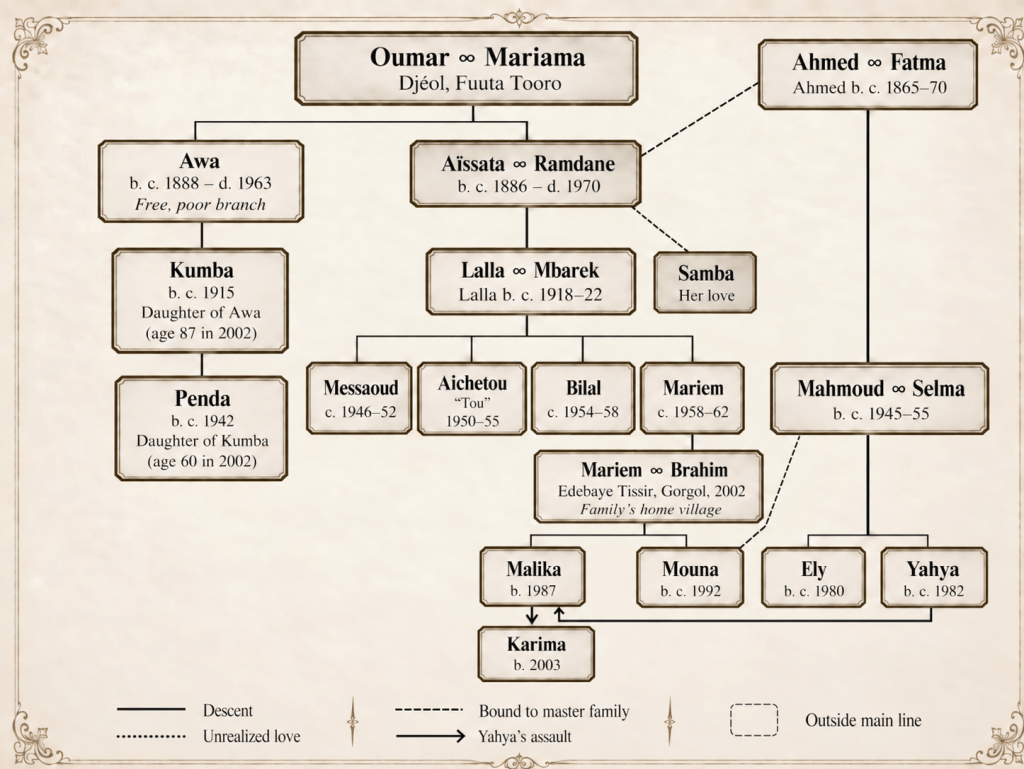
For Storymere specifically, the cast was so large, I needed a visual to help me easily see relationships. This family tree helps with this.
- Live in a few websites: WHO, U.S Department of Justice, JSTOR (it gives me scholarly articles/newspapers, etc), United Nations.
How rigid is your story map / outline?
- I deliberately make this so that it’s flexible. While it is very structured once I draft the outline for the section, I deliberately do not draft the outline for the whole novel. In the below image, you can see Section 2 is blank. That’s because section 1 is not complete. This allows me to incorporate or expand ideas / motifs / symbols that I did not expect to happen but that showed up anyway during the writing. A very good example of this is the witches’ voice in Echoes of a Wild Girl’s Drum. They were never meant to have their own voice. But, during the actual writing of section one, I realized I wanted to know more about them than what Soryelle or Maikel’s POVs could give me. They needed their own voice.
I was able to work that in seamlessly through the rest of the book because its outline wasn’t drafted yet. So I could easily slot beats or entire chapters in without disrupting or changing the heart of the section. I usually start drafting the outline for the next section when I’ve got about two or three chapters remaining in the current section. At that point, I’m close enough to the end of the section to know what the motifs/symbols/subplots have emerged and which ones I want to carry through. - Another example is actually in Storymere. I’m only on chapter three right now but already the idea of colors has become important and that was not something I anticipated. Since it’s here, though, it’s likely one I will deliberately use moving forward to deepen the story.
Ultimately, my stories are about my characters. If a character doesn’t like something in a beat, that beat doesn’t get written. They are helpful because they help me keep everything organized and they also help me ensure I tie up loose ends and plant “seeds” for the readers that carry the book. But they are not set in stone: they evolve just like the characters do.
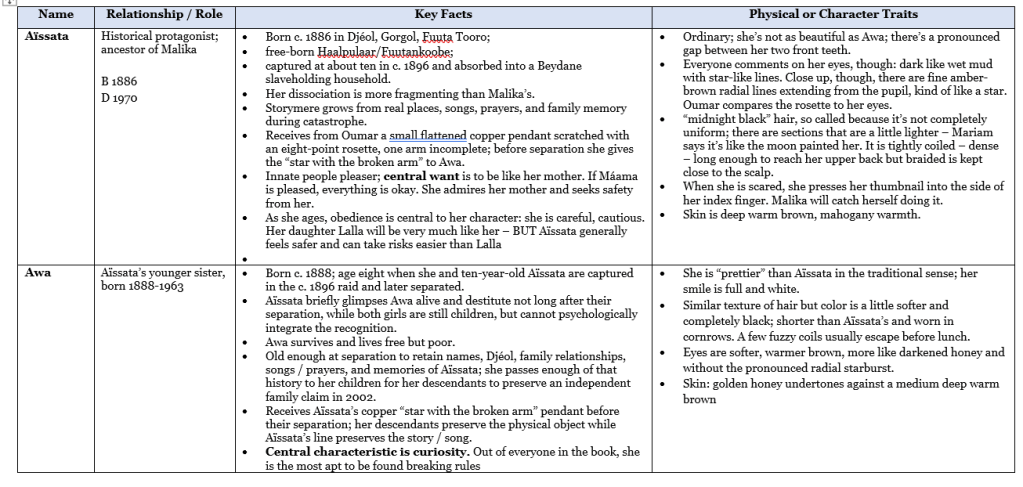
What do your character sketches include?
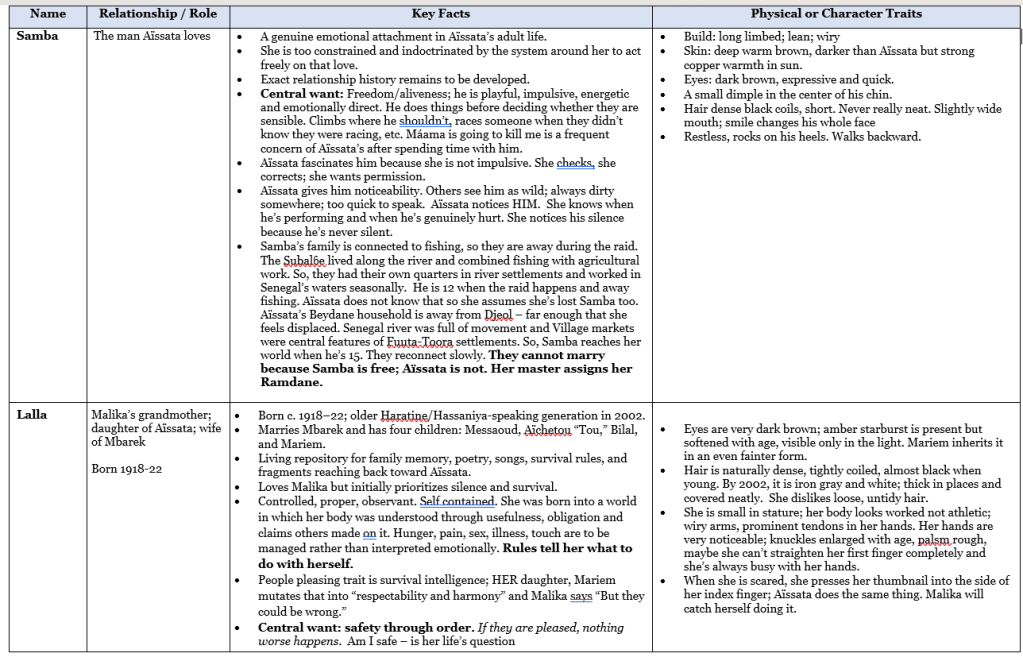
- See below. The thing is: central want – I will return to this frequently to make sure I’m building the character who has lived in my head for weeks or months. The physical traits help me keep hair colors and things straight. For Storymere specifically, the character sketches are doubly important because it shows inherited traits. For example, the “starburst” eyes and how this gene shows up a century later in Aissata’s descendants.
Is writing fun?
Yes… It is also a lot of work. And it is also very emotional. But the characters are my friends and they enable me to touch very real, very sensitive things, very hard memories that I can’t otherwise touch. They serve a very important role in my life. Watching their stories become full … matters.
How do you think of the settings / topics for your books?
Okay, so, let’s stay with Storymere as an example.
I didn’t see Aissata first; I saw Malika and I knew her name (that’s important). And I knew that FGM (female genital mutilation) was part of her story. I didn’t think, “I want to write about FGM,” I saw a girl in my head who was a survivor of that. While the topic has been on my “interesting; I think I want to cover that” list for awhile, it wasn’t something I was ever sure I’d write about.
The other thing that happened was I saw an old character I love. That character said, “Come mere.” Many years ago, in the middle of being raped, my ceiling opened up; the plaster became mountains and I simply didn’t feel as much as I had moments earlier. I watched my characters enact entire scenes that I would then go on to write in a book. But. Intense pain — the moment of penetration — had the power to collapse the entire scene and throw me back into reality right as the pain was unbearable. It wasn’t usually long because I would immediately panic, feeling as though I couldn’t breathe again and, once the moment of pain started to dull, I could find my characters again. Once, sliding down a hill, one of them said, “Tiffini, look!” loud enough to literally pull my mind away from what was happening to my body. I looked and saw a horse running toward me. I could breathe easier and the pain became numbed a little more.
So, when this old character said, Come ‘mere, I knew where ‘mere was: it was the ceiling. It was the magical world that opened up right when I needed it the most. It was dissociation.
That made me cry.
I’ve written dissociation in many books. But never about dissociation. Storymere is quite literally how I survived childhood rape. Now, I knew three things: Malika was my character’s name, she survived FGM and her book wasn’t really about FGM as much as it was surviving trauma through dissociation.
So I went to the WHO site and started researching places where FGM occurs. Once I had a solid list, I went a little deeper. I wanted to know of these countries, which ones also face other human rights issues and what are they? WHO helped me narrow that down. Suddenly, I learned about inherited dependency and how this same country where FGM was practiced and that faced post-abolitionist slavery (was the last in the world to abolish and criminalize slavery, actually) also held zina law. I read specific cases — actual cases — of some brutal things.
The deeper I researched this country, the more I knew: this is where Malika is.
And that guided the rest of the research. At the same time I was research her land and home, I was also expanding her story as she told me more. Soon, I understand that I couldn’t just write Malika’s story because it was integrated with her ancestors. And so we have Aissata and slavery and the whole century between the two girls.
Sometimes it’s much simpler.
For Dance for Me, I had an image – very distinct, very clear – of Maelea’s home and her first words to me were “write about my home.” Curiously, despite knowing what it looked like, I had no idea where she was from. I wanted her from the United States because I wanted to show that trafficking is not a “third world problem.” Lo and behold, that was not her story. I knew from the image that she wasn’t American and that she was somewhere in poverty. I researched “third world images” and on the first page there was an image that matched the one in my head down to the dog. I clicked until I found where the image was taken: Cambodia. And then I started researching how prevalent the issue of child trafficking was there and – well, that was my story.
When do you expect the two books, Moin & Marrow and Storymere to be finished?
If pace continues, and the story stays true to what I think it will, Moin and Marrow will be the lighter of the two. I anticipate it landing somewhere around 100-120K words. I should finish that sometime in December but I’m allowing for delays due to holidays or exhaustion or trauma chapters and saying end of January.
I expect Storymere to be longer, somewhere around 150-170K words, which should add a week or two. Mathematically, if the pace holds, both could be finished by the end of January 2007
Have you always had the same process?
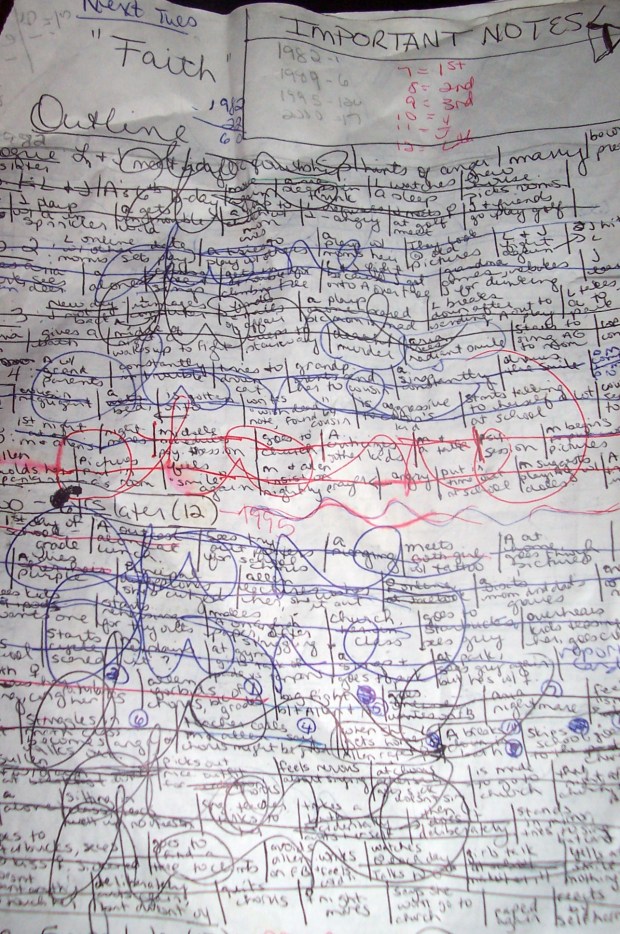
I’ve always written ridiculously detailed outlines, yes. There have been a couple of notable exceptions: The Character and Ash and Forget Me Not were written 100% without outlines. Actually, they were written as individual scenes – they were not even in order. The thought terrifies me now. But, again, I write whatever the character says write. Other than those exceptions, I’ve always worked with an outline. Below is an outline for a book I wrote in the 9th grade. Dare you to try to decipher.
What’s your writing process?


@tiffinijohnson.com How do you make such a long post, is it up to the instance? Also did you make your own mastodon instance? That is awesome I've got to try that.
The length really depends on the post; I’m rarely out of words. 🙂