The Breaking of Rules
I’ve been writing books a very long time. At least 38 of my 45 years. I’ve got oodles and oodles of stories. And hundreds of hundreds of characters. With a handful of exceptions — Taya, maybe, Ainela, Aria and, arguably, Alina — my female characters are pretty consistent. Wary, wounded, artistic and resourceful. I won’t say they need rescue, per se, but they do need someone to at least point out that a different way exists. Again with the exceptions notated, most of the time they are highly unlikely to “rock the boat” or break rules because they have been taught that obedience is the only avenue to safety. Lying to a parent would never cross their minds. They might sneak out of the house — Daphne and Abrielle both guilty of this — but only out of necessity (hunger drove Daphne out; protecting her sister drove Abrielle). I’m almost halfway through section one of Móin & Marrow and Bréaca has lied to her father, snuck out of the house at night, exaggerates stories and, generally, pushes the boundaries of what others expect her to do.
She’s different than even my exceptions.
Ainela was openly defiant, and proud of it. She wanted to rock the boat. It was the one time she didn’t that was the most heartbreaking in the book. Bréaca doesn’t intentionally want to disobey; she just can’t help herself. She isn’t trying to change a system or even operate outside of it, necessarily. She just wants to be… Bréaca.
Aria and Taya wore defiance as a mask. “At least they’ll have something to talk about.” They broke rules because they were already being bullied and / or abused. If Taya couldn’t make them her friends, then she wouldn’t sit idly by: she would at least give them something truthful to say about her. Taya’s natural defense mechanism was anger and that came across as rebellious. Bréaca isn’t angry. No one is abusing her in any way (yet). No one is bullying her (yet). Defiance is not her defense mechanism; it is just who she is.
Alina was blind and, because of this, she valued independence above all else–even friendship. Even, when push came to shove, her brother. She wasn’t defiant, but she was just this shy of disloyal… because she was trying to prove that she herself was worth something. Bréaca isn’t trying to prove anything, not even that girls deserve the same privileges as boys. She’s willing to live inside a male-dominated society… as long as she can also be safe.
An analysis of my female characters’ evolution fascinates me because of what it might say about how far I’ve come — or not. Because, interestingly, I struggle with independent-minded female characters. One of the things I’m grappling hard with is that nearly every one of my characters – I can’t think of a single exception – had something or someone to help her find a path out. Sometimes it was the arts in some way (drawing, music, writing, dancing). Sometimes it was nature. Most of the time it’s been another person. By the time the story finishes, Bréaca doesn’t have anyone or anything to help her. There’s only about 2.3 million rabbit holes I could dive into about that but, suffice to say, it’s playing hard with me. Also, a small confession: most of the time, I don’t like my independent-minded heroines, like Ainela or Alina, as much as I do characters like Daphne or Soryelle and I think that’s because they have to fight harder and the fighting changes them (cue another million rabbit holes).
I know I’m still very early into the writing of this book but, so far, I’m finding I’m quite loving Bréaca and her spirited self. Below is a random excerpt.
For context:
In this sample, Bréaca is ten and Lugaid is fourteen. They are not, and will not ever, be romantically linked: they are, however, friends. Lugaid becomes important because he is the only one who truly sees Bréaca for who she is–and accepts her as such.
Tentatively, this should be published in early 2027. You can read a lot more on the pages for Móin & Marrow . Also, if reading about the story, which, at its heart, includes themes of domestic and sexual violence, stirs some tender or vulnerable things, The Holding Room has a ton of things that might help.
This is copyrighted material and every word I write carries hidden memories of my own life; link to your heart’s content, but please do not try and steal my work.
In 2023, human remains were uncovered during peat harvesting near Bellaghy, Northern Ireland. She had lived more than two thousand years ago. Her head was missing. Plant material remained gathered beneath her knees. Archaeology can tell us something about how she died, but almost nothing about who she was.
Móin & Marrow begins in that silence.
Rules to follow if I am to escape a never-ending parade of tasks: as soon as I consume breakfast and complete morning chores, leave. The earlier I disappear, the easier it is. There are always things to be done and Máthair always summons me to help if she sees me. You will need to know how to do these things on your own soon enough.
But soon enough is not today.
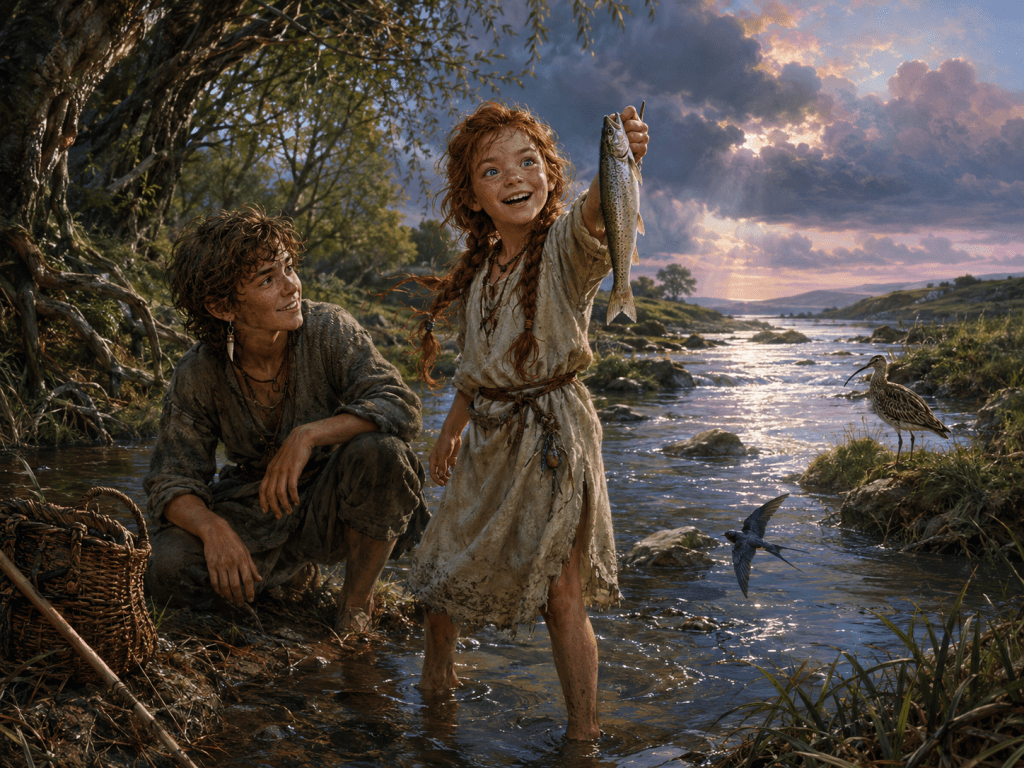
The morning wakes slowly. Purple and pink streak across the pale blue sky before the sun washes the colors away. A robin flies past; I run after it, spreading my arms as if they were wings. If I run fast enough, maybe the wind will pick me up and I can fly too. I won’t have long at the river; there are chores still. Athair says I will have to learn work before play but I say play helps me work.
I hear it before I see it; the sound of water babbling over stones and rushing toward the sea. The ground shifts as I walk down the hill toward the river. Near the wetlands, it’s bouncy; here, it’s soft and cool. A long keening cry comes from somewhere ahead of me; I stop to listen again. Sometimes the wind hides the sounds but I know them; I recognize Crook. He’s different than the other curlews; noisier, as if just by being loud, someone will listen to his whining.
I walk faster when I see the alders and their curling roots; the river is just around the waterhole. The mud slides between my toes and tickles, reminding me I can’t run fast here; if I do, I might slide down the last hill into the river. Sometimes I do that on purpose: once, after a heavy storm, I ran so fast down the hill that I fell on my bottom and the mud carried me so quick Ailill couldn’t catch me. The splash my body made as it threw me into the river made me and Lugaid laugh. Ailill and Máthair were not as happy; Ailill slid too, but not on purpose like me, into the water. He said it was the last time he would save me. Máthair wasn’t happy because she said she had two wet chickens for children and no time to dry and dress them.
The riverbed is more crowded than the village; the alders don’t lean like the hazels and blackthorns do, but the sallies do. I love watching their skinny arms draw pictures in the water beneath their reflections. Instead of the wind, the river fills my ears. A dragonfly flies by my ear but my eyes light up when I see Stitch. The blue and black bodied swallow darts back and forth, poking holes in the morning sky before dropping so close to the water her belly nearly touches it.
Crook cries again from somewhere behind me now. “I know,” I tell him, twisting to look behind me.
“What do you know?”
I gasp, turning forward again.
Lugaid stands on the other side of the sally, arms outstretched, a pole in his hand. “I didn’t see you,” I say. My splashing makes Stitch soar up, up until she drops farther past Lugaid to the river again.
“It’s going to rain. Stitch and Crook say so.”
Lugaid shakes his head, shrugging a curly lock of hair the color of bark out of his face. A small fragment of a boar’s tusk hangs from his right ear. It never comes out; he’s worn it since his first kill, three summers ago. “The water seems higher,” he agrees.
“I want to do it.”
He cocks his head back toward the shore. “Find a pole and a worm for bait.”
“Athair catches with his hands.”
“Athair is not most men.”
Lugaid stands still, the water flowing past his ankles. Finding a stick isn’t easy; they are either too short or too long. When I am tired of looking, I take a longer one, bend my knee and snap it over my leg. The branch cracks in just the right spot.
“You need a worm for bait,” Lugaid offers. Something in his voice makes me look up but, when I do, he’s turned away from me, staring back at the river.
Worms are easy to find; they live under the wet ground. The sight of mud slipping beneath my nails as I dig makes me think of Máthair: I’ll have to wash my hands before going home. Ériu shares a plump one; a dark brown, ribbed body pulses as it inches along. My fingers snag it; my eyes furrow.
“How—” I look at the stick, then back at the worm.
Lugaid glances over his shoulder just as I take the sharpest edge of my pole and thread it through the worm’s body.
“Use willow—”
“I baited it!” I hold the pole up proudly and Lugaid closes his mouth. Thick, dark brows touch his hairline as he nods. “I see. Hold the end of it and cast it—throw it in. Get it into the deeper water.”
When I walk through the water, Lugaid says patiently, “Any louder and you’ll scare the whole school. You have to be still and quiet if you want fish.”
I slow as a beam of sunlight breaks through the trees to dapple across the water. “I see one!” I say but I make sure to say it quietly. Beneath the water, a single trout swims nearby.
“Catch him and you’ll have breakfast.”
“How long does this take?”
Lugaid grins sideways, lifts a shoulder. “As long as it takes.”
Insects hum around us, the sallies lap the water with their branches, the birds chatter. It’s not quiet, but it feels quieter than the village. Just as I start to ask Lugaid if he thinks so, too, he sighs heavily and rubs the back of his neck with one hand.
Your arms look like twigs, I tell him this sometimes but it’s not as true now as it used to be. Lugaid is like me: it’s hard for him to be still and it’s harder for him to be quiet. His eyebrows still look like Stitch knitted them together; he doesn’t usually walk around with them like that.
“Why are your eyebrows like that?”
He slants narrow eyes toward me. “What? Like what?”
I make a face, working hard to draw my eyebrows as close together as I can. He scowls back at me, shakes his head and mumbles, “Nothing.” Then, “I shouldn’t’ve done it.”
“Shouldn’t’ve done what?”
“He promised me he had it,” he murmurs, looking away from me. He sighs again. He shifts his weight from one foot to the next and I want to tell him that he said we have to be still and quiet or we’ll scare the fish.
Before I can, something tugs at my stick.
I gasp. “Lugaid.”
“Ha! Look at that, you got something. Don’t let him go now. Hold it, move with him, like this—” he gets behind me, holds my arms and helps me hold the pole while also moving further onto land.
“Over your head, now!”
We pull the stick up, hard, up and behind me. Then we rush to the fish who flaps his tail every which way. “Hold him still,” Lugaid says. He finds a large stone and raises it above his head.
“Don’t you dare!”
He pauses, looks at me. “What?”
“He’s my fish; I’ll do it.”
Lugaid laughs. “Right. Should have known. Here.” He hands me the stone and uses one strong hand to hold the fish on the ground. My eyes are huge when I bring the stone down twice, then pause to look at Lugaid, “That good?”
He nods, so I throw the stone away and immediately forget the fish. Instead, I jump and spin, throwing an arm in the air. “I caught a fish!” Lugaid laughs at me and says, “Well, what about gutting him?”
I still, my eyes finding the fish.
“What?”
“I can do it for you.” His tone says he knows he will not.
Máthair cleans fish; I’ve seen her. The men bring it back; she cleans and cooks them. I push my shoulders back. “You’ll show me how.”
Lugaid moves to sit beneath an alder, motioning for me. “Come on, then.”
Sun rises higher in the sky as he tells me where to cut the fish. I gag and nearly let him take over twice, but he just grins at me and says, “What a girl you are” and that makes me mad enough to keep going. By the time the fish is gutted and cleaned, we hear the distant sound of thunder.
Stitch and Crook were right.
Lugaid and I race back to the village and I am holding breakfast up high, calling, “Máthair! Athair!” the whole way. See, Athair, I’ll say, Play is work!

