The Missing Beat: What I Never Said
The following is an excerpt from ECHOES OF A WILD GIRL’S DRUM, set for release in July 2026. This excerpt is a letter from Maikel to Soryelle. It concludes with an audio recording of their intimate, private, made-up beat. Better known as The Missing Beat.
I missed it.
When I held you in the square, the only thing I cared about was seeing the hazel sparks in your eyes again. The only thing I felt was the temperature of your body cooling against the raging inferno of mine. The only thing I heard was your silence. Your lips gave up the last drop of sugarcane I’ll ever taste—I haven’t wanted food or drink for days because I don’t want to wash it away; I don’t want anything else touching my mouth.
I wanted three things in the final moments of your life, little one. I don’t know the full lullaby; I’ve only heard the fragments you whispered at the stake when you were little and the lines you’ve whispered since. All I know is that it says ginger will stop shaking and honeysuckle keeps fear away. I don’t know if those things are true, but it doesn’t matter. You thought they were.
The first thing I wanted in your final moments was for you to not be afraid. If we’d been in Kavaru, I’d have laid with you amongst the honeysuckle stalks, surrounded you with them. You struggled to breathe—I could hear your lung filling with smoke—so I would have put the buds near your face so the scent of wildflowers and honey could take the fear away. I wouldn’t have released you—no, my arms had nowhere else to be but around you—but I wanted every fear you’ve ever had to leave you and the flowers never lied to you like I did.
I told you that you were safe with me no matter where we were. And, when the last of the flames was gone, and I held your blistered, burned body to me, that broken promise played like the loudest Judgement Beat I’ve ever heard in my head. I remember every time you flinched when I went to touch you; I remember how you would take something I said and fear it was proof of all the lies you heard.
Everybody lied to you.
Clan Mother lied to you by giving you grey cloth at the end of your three days at the stake, as if saying she cared about you and would give you somewhere soft to land. You clung to that lie for twelve years hard enough that you left Salu at her doorstep because you wanted your daughter to know soft things. But it was a lie. A villager who was there told me what happened and how she took Salu’s arm, pulled her away from you—and never looked at your face, never spoke to you. What good is a soft thing if it’s yanked from you just as the world ends?
Ruvan lied to you. I heard him the day the boys were throwing things at you. You chased them, threw things back at them because you still believed then that boys should be dealt with for harming your body. And Ruvan told you he’d talk to them; he’d take care of it. He did talk to them, but he didn’t keep the crowd from throwing rotten fruit at you when you were tied. He didn’t keep the villagers from shoving you, slapping you, starving you.
The glassman lied to you. He told you that your mother was a witch; he told all of us that she fed you a baby’s heart, and that you were different from the rest of us. He was right about that part—you were never like anyone in this village, not even when you were four years old and throwing blackjack petals at your mother’s burned corpse. You cared for a tree kangaroo that did its best to tear strips from your skin for it. You touched a piece of blue fabric in the market as though it were nothing but a dream. Your laugh, when it came, wasn’t the safe, quiet kind allowed: it was usually wild, usually loud, always full and always, always the truest thing in the forest. You were never like us: you were what we lost—some of us lost it during the Long Night, most of us never found it because we were never told it existed. The glassman’s lies told you that what was different about you was hideous but he was wrong. What was different about you was freedom.
Wapi’s lies were the ones you couldn’t outrun. His were lies you couldn’t silence, even when I was the one holding you. I heard them fall from your mouth easily, as though you were telling me the color of the sky. Small things—like the glassed-over look in your eyes when you’d go somewhere far away I couldn’t follow or the way you’d brace if I moved too fast—told me he’d carved his lies into your bones. More than what he did to your body, these lies are the reason I will destroy him.
But I lied to you, too.
Every time you said something that I didn’t immediately correct—I let all the lies you’ve ever heard grow. Every time I held your wrists tight enough that you had to rub the soreness out of them, I told you that your movement wasn’t free. I’d give the very beat in my chest to have you touch my face again. I’d climb back into that hole in the ground with you if it meant you might wrap your arms around my neck. You asked me if I’d hold your hand and I told you, ‘Always.’ But I can’t hold your hand now. I told you it didn’t matter where we were, that you were safe with me. I was within hearing distance of you and you are somewhere I can’t come. Now it’s my movement that’s bound.
So, hearing me tell you that you didn’t need to be afraid when the heat of the flames still tore through your skin and you couldn’t smell anything but smoke… well, I didn’t even believe myself. But it was the first thing I wanted: not to be afraid.
The second thing I wanted on that awful day, when I knew in the marrow of my bones that you were leaving and nothing I could do would stop it, was to be held. Do you remember telling me that your mother thought you might have been a star once and that, if you were, you hoped you were part of the band of stars that curve and stretch across the sky? You said it was as though they were a village, all together. Sometimes, late at night, you’d wake up beside me. You’d sit up and stare into the darkness—and you’d wrap your arms around your own waist and start rocking back and forth.
“Come ‘mere,” I’d say and try to gather you close. You always let me.
But you were afraid.
Not of me, for me.
Convinced that I was going to be poisoned somehow if I held you in my arms, if I touched your mouth with mine. I woke often to find you watching me and the moment my eyes opened, you visibly softened. Your shoulders would drop, a tiny sigh of relief filling the space between us. It took me time to understand: you waited for me to open my eyes to prove you hadn’t made me sick. That I still breathed. You feared every touch you gave me because it might have taken me from you.
Hear me, Soryelle: wherever you are, hear me.
We are not in the same grass anymore, but we are not apart. I see you everywhere—in the star-shaped mark near your daughter’s eye, in the tree kangaroo, and every inch of Kavaru. Sometimes I go to the tree and sit beside you. Sometimes I walk to the waterfall and cross that log to the Missing Beat. I found more pouches you hung. Salu calls it a treasure hunt, trying to find them all, but I hope you hung so many we never find them all. You are everywhere in that forest. And I see you every night when the blue sky turns black and the stars turn on.
I feel you.
I swam under the waterfall and I felt you there with me. When your daughter hugs me, I feel you. When the wind blows across my chest, I feel you. When my hands strike the drum, you’re beside me, reminding me to feel the beat, not just play it. It’s in these moments, touches of yours, that I draw the only breath I still have. The spaces between these touches of yours and every other moment are suffocating. I told you that I only hurt when you weren’t touching me, and that is truer now than it was then.
I shake for want of you.
And I breathe by memories of you.
So, in that moment, my whole chest longed for you to feel held. I held you so tightly to me because I wanted you to feel my hands, my chest, my breath more than the flames. I didn’t want you hurting; I wanted your pain—all of it—to be what died in that fire. In my arms, I hope you felt held up, Soryelle, not down.
Let my arms be what carries you away from this village. Let my arms be what holds you when you can’t make out the shadows. Let my arms be what guides you to a place where the stars spend eternity telling you that it is your touch that lights an entire sky.
The third thing I sat in that square wanting in those last moments was perhaps the most important one. You saw things in a way I never have. You heard things I didn’t, not even when I tried. You danced; you climbed; you crawled; you splashed. More than once, you jumped out of a tree, landing inches from my face as I came into Kavaru. Your laugh startled birds and the bandicoots; you were loud and unpredictable and you laughed as though you were never going to stop and you awed me. When we slept in the tree, I told you I adored you—I didn’t say loved because what is love?
For all I had that you didn’t, you had something once that I never knew: someone who loved you. As she burned at the stake, I remember listening to you scream her name—and I remember she screamed for you to close your eyes, to not look. When you were four, your mother loved you.
The only person who has ever loved me was you.
And you gave it as you gave everything: freely.
Once, you found sap leaking from a cut in the fig tree and you gasped as if the forest gave you treasure. “Dragon honey,” you said and it wasn’t just your mouth that smiled; it was your whole face. I told you dragons don’t make honey but you said this one did because he was special and old and liked sweet things.
I didn’t know how to see what you saw.
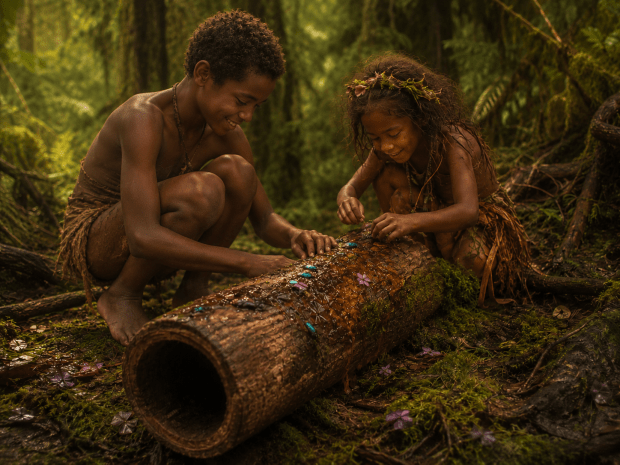
But we used twigs to smear the sap along the hollow log and then you pressed petals and I found tiny curls of bark and we both found beetle wings to add to the sap.
You said, “Look, his scales have grown back!”
My fingers stuck together. Yours did, too, but when I pointed this out, you laughed, held both hands up like claws and said, “Mycal, look: now we’re turning dragon!”
Soon, we chased each other through the forest with our claws. I caught your arm with my sticky claws and said, “I got you!” But you said, “Wild things aren’t caught…” and your smile took over and you started laughing as you rubbed your sticky hand from my forehead and over my cheek, “but they might mark you!”
Wild things.
Holding you, listening to your breathing growing more and more shallow, feeling the trembling in your body, I couldn’t unsee what the flames had done. No—no, I know you hear that and think burn marks, blisters, ugly, but listen to me. Our bodies were both burned—my hands, my chest, they were scorched when I pulled you to the ground, when I laid on top of you to smother the flames. There was an instant, a heartbeat of time, when images of you rolled like thunder across the backs of my eyes. You, in all the ways you’ve moved.
“Careful, that sounds like you might like wild things.”
“Don’t you know? I dream of wild things.”
Maybe I lied to you, but I also told you the truth.
I told you I adored you because what you made me see and hear and feel was something greater than anything in my structured life. You took everything I ever knew and flipped it. It didn’t matter if I played the beat right if I didn’t feel it. Rolling around in the mud wasn’t pointless, it was the point. You couldn’t move in a way that didn’t mesmerize me. You couldn’t laugh loud enough for me. When you cried, you let your whole heart break in front of the whole forest.
Everything about you was wild, even on that last day.
You screamed my name in a way no one ever has.
I ran. I ran as fast as I could to get to you and, when I had you in my arms, you asked me if I was there. No one has ever loved me like you have, enough to want me near when everything around you is collapsing. I held you and I wanted you wild because I wanted you free—even if that meant you had to go where I couldn’t go. Where you are, I hope you are climbing to the top of every tree and dancing off beat and marking the skies the same way you marked me. My Soryelle: wild and flawless. You weren’t just a part of my life, you were the missing beat.
That’s why I missed it when I stood and carried you from that place. Because all I cared about was making sure you were not afraid, you knew you were held up, and you were still wild. I missed it the following morning because after spending the last night in Kavaru with you—washing you, covering you, burying you—I couldn’t feel anything. I don’t remember walking back to the village, and I don’t remember playing Heartbeat.
I don’t remember anything.
Until this morning.
After playing the drum, Ruvan asked if I’d help the soldiers with something (I don’t even remember what. People talk to me and I forget what they say within seconds now because they don’t matter). I walked in front of the stake and something caught the light just enough to turn my head toward the place I’ve refused to look at: the place where we sat, where you closed your eyes for the last time.
It was mostly covered over by dirt but a rounded corner refused to be hidden. My fingers brushed against the dry dirt I swore I’d never step on again. The button. I don’t know why it was the thing that cracked the hollowness in my chest, but I stood staring at the dirty, white button, and time faded. The first time I held this button was when I found it near the stake after I cut you loose. I kept it hidden in the drum because it was proof you were real and I gave it back because you needed that proof more than I did.
But you… you, being wildly you, knew I needed something of yours to hold. I don’t know how long I stood there, staring at this button, until I closed my fist around it. I’ll put it back on the leather strap, but I will not hide it this time.
The numbness wears thin.
Noise pelts me from every direction.
The sights, sounds, smells of this village grate on me.
And there is still one thing left undone.
I promised you.


[…] can read sample chapters here, here, and on other pages on the blog. You can purchase (without shipping fees) […]
Thank you for reading, Elias. This was very painful to write. While I have not lost someone in this way (this is an excerpt from my forthcoming book), I am a survivor of rape and I use writing as a way of healing. And your reminder that it’s not a straight line came on a day where I needed the reminder. So, thank you.