The Shape of (Free) Echoes
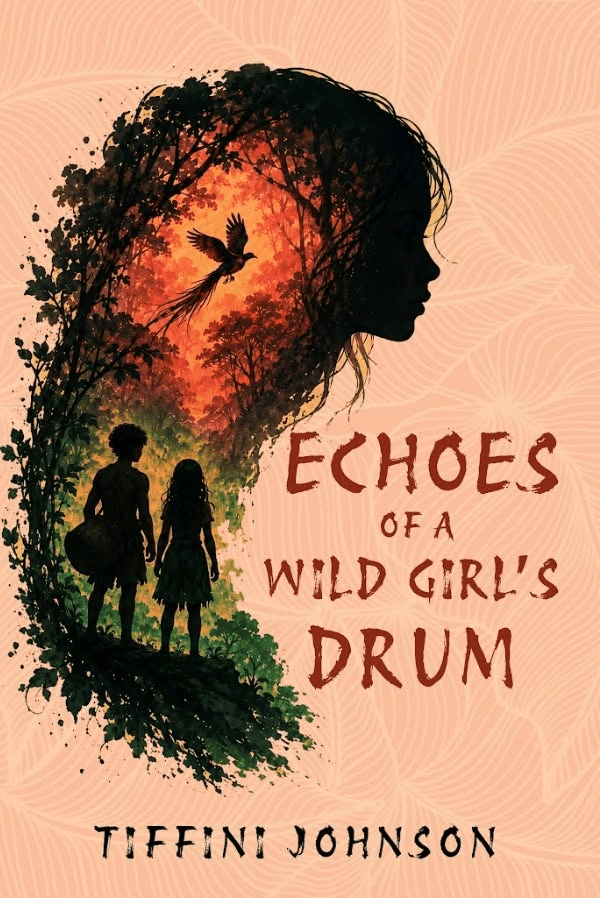
Today is a day of celebrations: America turns 250 years old—and Echoes of a Wild Girl’s Drum , the Kindle version, is available.
And it is free for the next 4 days!
Reviews from the beta readers are coming in, and what stands out as a consistent theme are phrases like “emotional depth”, “unforgettable” and “character driven.” They stand out because I fought line by line to keep this story from being conventional.
I did not want Soryelle to have the conventional arc where she becomes “empowered”. Instead, I wanted her life to reflect emotional truth I’ve felt as a survivor of trauma. To people like my editor this meant conversations like “you might have room to trim some of the longer passages,” to which I said, “No.”
I struggled with the ending. Everything in me rejected the idea of her being watched as if she were a spectacle as she burned. Everything in me violently objected to the idea of her being unable to move while in pain. Mostly, though, I could not survive her death if she questioned, even in some deep, unstated part of her that she was not loved. That meant I needed her to be held.
Which is a little ironic because being held implies constraint and yet it was also the thing I felt made her the most free.
Freedom is not about being explicitly unbound. Freedom is being safe enough to be expressive. Freedom is having the permission to be exactly who you are—without judgment or ostracization. True freedom, then, isn’t anarchy. It’s a set of rules that protect one’s ability to speak openly, move without inhibition, and define your own life and doing all of that while being held and supported. As a survivor of trauma, I’ve felt the greatest freedom when I’ve been confident I am loved.
Soryelle’s journey is not a direct route to healing: it runs toward it, then gets completely roadblocked and loses a few steps. She fights a fairly consistent war against conflicting voices in her head: severe trauma says you are dirty; you are condemned while Maikel says you are loved. Sometimes the trauma voices win; sometimes Maikel wins. But the real point is that trauma has so deeply marked Soryelle that her worth is always evaluated against someone else’s opinion: readers have to ask does she ever determine her own worth? And, if the answer to that is no, then is she ever really free? Is the emotional wave of hearing something like you are disgusting and still choosing to do whatever it is you want in that maoment proof you’ve overcome or is it merely proof that you’re still fighting? That maybe you win the battle today but you might lose the battle tomorrow when that voice comes back?
I was not very interested in the final outcome—I cared about the fact that there even was a war. I cared about the battles. Because the cost of each individual battle is greater than the momentary win or loss. If I hear trauma telling me I’m not a real writer and yet ignore that voice by publishing a book-I’ve won the battle that day. But I also feel the impact of that small victory: reviews, conversations, connection that validate the truths shared in the story that make me feel exposed and vulnerable. That validation might give me a stronger shield with which to fight the next time I think, “I can’t do this.”
But if I lose the battle, the impact of that loss means I might have less proof to support me when I’m faced with the same fight the next day. Losing one battle means I might also lose the sense of being held by connection and hope. And that—well, the question is: can that create a string of lost battles that make the war harder to ultimately win?
Maikel tells Soryelle, I hope you felt held up, Soryelle, not down. The story I wanted to tell was what’s the difference? Isn’t the answer the shape of the hold?
Convention encourages writers—and humans—to discard the trauma echoes and keep the good ones. The space between the echoes and the choosing is Soryelle’s story.
This story cost me some skin. There are things in it that I truly experienced in my real life as a rape survivor. Some of the echoes that Soryelle fights are my interior war in ink. She catches sight of herself clean—and does not recognize her reflection because she feels dirty. I spent years self-harming because the image in the mirror did not match what I saw myself as on the inside. What she wants most is to be seen; I’ve feared being invisible and forgotten my whole life because the abuse echo is that I do not matter. She stubbornly and consistently uses nature—the stars, Kavaru’s animals—and her relationship with Maikel to see beauty and redemption in life despite the negative echoes. I have spent 35 years looking unflinchingly at the absolute worst in mankind—the Holocaust, Rwandan genocide, Cambodia’s child sex trafficking, Romania’s Iron Curtain orphanages, Papua New Guinea’s sorcery related violence (witchcraft), racism, teenage suicide, child sexual abuse , domestic violence — to find proof kindness is stronger than evil.
What I hope readers of my work leave with is not a happily-ever-after. Instead, I hope they emerge feeling a little more held because they’ve been seen. Winning is not really the hope. The hope is in connection because connection whispers that someone will choose to walk beside you into the battle. Strength is opening your eyes. Strength is rolling out of bed when you don’t really have a good reason to. Doing so creates an echo you can use tomorrow: I did it yesterday; I can do it again until something new happens that makes you think, wow. -I- did that.
Here’s the thing: kindness is stronger than evil. And it is stronger because kindness reflects who we are beneath the ashes. Kindness is someone recognizing who you really are and responding to the worth of that. Kindness matters because it’s a rainbow in the thunderstorm—it says, “yes it’s raining but I see you.”
Echoes of a Wild Girl’s Drum is one of my favorite stories… because of the relationships between the characters and how the echoes of those relationships create more than change: they create hope.
I cannot wait to hear what you think of the story and its characters. And if it leaves you wondering what might happen if you shared your thoughts… I’m only an email away.
 Tiffini Johnson