
Where the Witch Burned: A Child’s Memory of the Square

A new story is in the works!
This one explores human sacrifice, specifically SARV (Sorcery Accusation Related Violence). It wasn’t until 2025 that someone actually spent time in jail for making an accusation of witchcraft in Papua New Guinea (PNG). This story goes back further to understand the roots of the superstition. It follows Soryelle, the young daughter of a woman burned at the stake for witchcraft, and Maikel, a young boy chosen to be the village drummer.
In the Highlands, the drum is more than music — it is law. Its rhythm summons warriors, names sinners, decides who may breathe and who must burn.
Soryelle was born beneath its echo. The witch’s child. The girl whose mother’s ashes still haunt the village air. When another baby dies, the whispers return, and the crowd gathers. Smoke. Chant. Silence. And a boy’s trembling hands over stretched hide.
Maikel was raised to keep perfect rhythm. But the night he plays for her, the cadence falters. One beat breaks — and so does the law.
Together they flee into the jungle and carve Kavaru, a hidden sanctuary where no rhythm commands them, where the forest itself keeps time. There they learn the language of survival, of love, of what it means to belong to no one.
But fear travels faster than sound. When the drums rise again and the village demands her death, Maikel must face the truth he has always known — that the rhythm he serves feeds on obedience, not justice.
By the time the last drum sounds, the question will no longer be who the witch is — but what it costs to break the song of obedience.
Below is the Prologue!
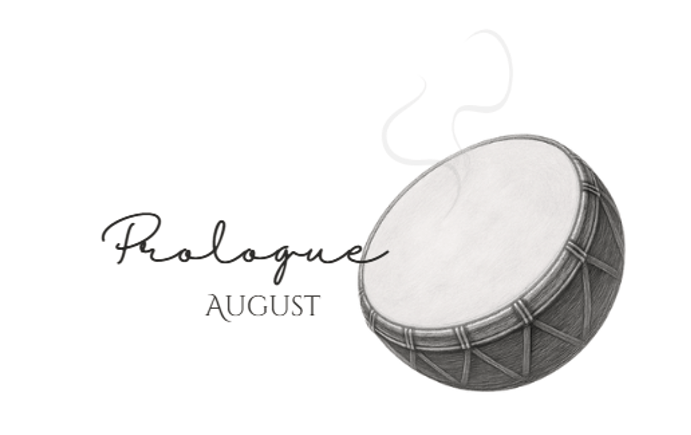
The world is a giant. I can’t see Nángi because everybody is so big. She says I am a big girl now, so I crane my neck high, trying to see around legs and bellies. Everybody keeps pressing on me. People on all sides. I look up, way up, and shout, but they don’t hear me because I am too little. I am trapped in the middle of the giants. Dogs bark, white and black spotted fur flashes near the ground. The ground runs, rocks and dust fly up, and still they walk, pushing me along.
I want my Nángi.
I am going to die today in the square, Soryelle, but I haven’t done anything wrong, no matter what they tell you. That’s what she said, just before the men grabbed her and took her from me. She said she was going to die in the square, and then I saw all the people from the village walking that way. Some ran, some walked, all yelled. And then, I was in the middle of them, even though I didn’t want to be.
I hear her screaming. One time, Nángi and me had a screaming contest. We scared the cassowary birds and rabbits away. Not all screams sound the same. There are happy screams, like when she tickles me in the grass until I can’t breathe, and mad screams, like when I run near the spirit house even though I’m a girl, and there are scared screams too. Nángi says my scream sounds like an angry baby’s wail. Nángi’s is rare but, when it does come, it sounds like lightning splitting the sky.
The world is very loud. Everybody shouts; the bodies around me scream, jab fists in the air, yell, “Let the witch burn!” The dog barks again. A baby cries. Two elders yell at move. But the loudest thing I hear is Nángi’s scream. It is not the happy or the mad kind. It is the scared kind.
She sounds close, so I push my shoulder against the legs of the people around me, shoving my way through the crowd. Tio tru em i kam long ai. She says tears show the real heart. Mine is scared and sad, so I cry. “Nángi!”
“The witch’s daughter.” The woman sells bilum at the market. Once, I saw one she made with black and red triangles. It was so big; Nángi said it could carry me. I haven’t done anything wrong, no matter what they tell you. I want to yell it out, I want to tell everyone she’s not a witch. But I don’t because my insides shake.
Nángi screams again. Suddenly, the crowd freezes. The shouting stops. I break through the small spaces between bodies until there’s no more giants in front of me.
Nángi!
Two men in rough skirts the color of dirty water walk on either side of her. One of them carries a twisty rope in one hand.
Boom…boom…boom…boom.
The sound makes my heart jump. I look around until I see him. The drummer boy. He’s taller than me, bigger. He stands to the side of the crowd, tapping the drum slow. He doesn’t look up, even when a piece of hair falls in his eyes. I wish he would stop. I wish he wouldn’t play. That beat is played when people fall dead.
“Nángi!” When I cry her name again, she turns her head. Her cheeks are splotchy, and her braids come undone. Her eyes look everywhere. I jump up and down, twice, waving, and calling her name. She sees me! Nángi’s throat moves, swallowing.
Boom…boom…boom…boom.
The giants shout again. “Burn the witch!”
The sun is hot. It makes the back of my neck warm. When they tie her wrists behind her back and around the big pole, I run. I don’t get far when someone grabs my arm and pulls. Bigman frowns at me and says roughly, “Be still.”
Nángi is tied to a long stick, her hands high in the sky. The twisty rope bites her wrists, and she stands on her toes. They scrabble like she’s trying to climb air, trying to find enough dirt for her soles to rest. Her braid is all messy now and her black hair sticks to her cheeks.
Men throw dry sticks and tall grass around her feet. I can feel it, I know what grass feels like. It scratches. It smells like the garden after we burn it; smoky. Another person tosses more sticks, and they clatter loud, too loud. They sound like bones breaking.
See? It can carry you. She swung me high and low in the big bilum with red and black triangles in the market. I laughed so hard my tummy hurt. Nángi makes me laugh a lot. Nángi’s hands smelled of kaukau peel when she carried me.
Boom… boom… boom.
Nángi still watches me. Her mouth is open, but she is quiet. I can see her chest going in and out like we’re racing. Someone’s torch drips fire. Smells! There are so many smells! Sweat, pigs, smoke, mud. My knees shake; my hands are little fists. I can’t move even though I try.
Swoosh.
The torch strikes the dry grass and sticks. Flames leap. Boom…boom…boom. The drummer doesn’t look at her, but everybody else does. I try to run again, but Bigman’s hand grips my shoulder tight, holding me still. I fall to my knees, holding my arms out, and screaming, “Nángi!”
“Soryelle!” She closes her eyes and shouts, “Don’t look!” I close my eyes, squeeze them tight. The sound of sticks snapping, grass hissing, and flames leaping fill my ears. I squeeze my eyes tighter, feeling the heat against my cheeks. When Nángi screams again, my eyes pop open. Orange fire licks the edge of her dress and then climbs higher. Black smoke rises like a curl from her hair.
I don’t know if it’s my scream or hers I hear.
The people don’t make any noise. They are so quiet, even the babies stop crying. The only sounds are the scream, the crackling fire, my heart beating through my chest. It’s so loud it hurts. I press both my palms against my ears so hard I see stars. I rock back and forth on my knees. Smoke is grey; it gets thicker and thicker until it burns my eyes. Tiny sparks of fire leap, land on me. I scramble, brushing it off me, but it leaves a darkened stain on my dress, a mark.
The earth tilts, water fills my head. Time does that the funny thing Nángi told me about; it slows down. Time doesn’t always control us. Sometimes, when we just can’t take anymore, we can catch up by slowing time. It feels weird. I can’t feel the heat of the fire as much or the hissing of burning grass or even the drum. I hear my breathing, fast and hard.
Someone pushes me. I fall sideways, hitting the dirt. Sounds and sights come rushing back, running toward me, faster than before. People murmur now, shuffle as they turn to leave. Smoke still rises, flames still burn, but Nángi is still. She is quiet. Her black skin looks darker. She doesn’t look like Nángi.
The people leave, but I don’t.
I sit where the smoke and ash fall.
I am alone in the square when I see the blackjack growing just behind me. One time, a woman came to our hut; her hand bled and Nángi pressed blackjack to it. The bleeding stopped, and the wound closed.
I scramble from my knees and move to the edge of the path, plucking handfuls of the tiny white petals. Blinking away the smoke, I count them. How many blackjack petals does it take to make somebody alive? I am really careful to put the petals I count into a pile close to me, so the ash that falls won’t stain them. I can count high. I know it’s enough.
I carry the petals in my hand, curving my fingers around them so I don’t drop one. I don’t see Nángi. I only see a burned skeleton. I close my eyes and then toss the petals into the smoldering fire. The flame leaps, then falls. I stare at the burnt person, waiting for her to come alive. She doesn’t. Maybe I didn’t have enough. I go back and gather more. I am still throwing petals into the flames when the sun goes to bed.
 Tiffini Johnson