
The Note

The Backstory
Many years ago, I wrote a book called “Holding Home.” It was about two children, Michael and Mary Beth, whose father beat their mother routinely. They witnessed this, and Michael, the eldest, and a son, was sometimes forced to participate. There was no sexual abuse in this book. It was my one, and only, attempt at conveying battery. I did some research for the book, though, mainly because of what I wanted to happen to Mary Beth. Some of that research has stayed with me ever since, and it’s been gnawing at me for days.
The crux of it? Did you know … The decibel level of a scream is between 80 and 125 db. At about 85 decibel, CDC recommends workers to provide hearing protection: OSHA requires it. Normal conversation level sits at 60 db. So, if someone is shouting at you, and someone else is speaking normally, you can’t hear the second person because the noise level of the shouting is so high you need protection for your eardrums. Whatever is being said at 85 db demands your focus and your attention. But what if someone’s not shouting at you: what if you have two people speaking at 60 db – so normally – but one of them is saying something like “you’re worthless” and the other is saying something like “you matter to me“. At the same volume, you should be able to hear both and choose which one to believe, right? Except, no, not so. Because “negative bias” is real.
Negative Bias
Negative bias is a psychology term that says we are hardwired to respond more quickly, and ruminate on longer, negative information than we are positive. Our brains are more sensitive to unhappy thoughts or news and, once upon a time, it was to help humans survive. Today, instead of helping us survive, negative bias means we hear the person saying you’re worthless at normal volume quicker than we hear the person saying you matter to me at the same volume. Research shows that the negative phrase stays with us longer too and requires more work to eradicate. And, actually, psychologists have pinpointed a magic formula that tells us that, in order to remain healthy, we need five times as much positive interactions as negative. To combat that one person saying you’re worthless you need to hear the other person saying it five times more frequently, or you need four other people simultaneously also saying it. Literally, to “outweigh” the impact of the negative thing. If you have two people shouting at you, you need ten telling you something different in order for you to easily dismiss the two. And, if you don’t have that, those shouts might become your self-scripts: the core truths we tell ourselves about who we are, what we deserve, and our lives. If you internalize the shout, then instead of speaking at a volume of 85 db, you’re suddenly shouting it at yourself at a volume of 125 db (or higher). And that means it’s going to take that much more work, and people countering those scripts, for what you believe to change.
Combatting Negative Bias
I tell this to survivors because, if you don’t know, you can’t train yourself to hear the other things also being said. Combatting it is different for everyone. For me, reason helps: if I can disprove a thought, using logic, then it’s harder for me to accept it as true. If the thought crosses my mind, “I’m so ugly” – well, that’s a very broad statement. I need definition: what about me is “ugly” and what makes it ugly? What does the word ugly even mean and what was the original definition of that word? I go down so many rabbit holes it’s a wonder I find my way back out. If I try to answer the questions, I might say, “my whole body” instead of “I am.” Getting somewhere, but my whole body is still very broad. Narrow more. Eventually, I might land on something specific about me that I don’t like, say, maybe my nose, but then I have to counter it. Is there anything about my body that I do like? The automatic answer is “no.” But is that a trained response or is it the truth?
I have literally stood in a mirror and went from head to toe trying to find something about my body that I couldn’t find fault with. It’s really, really hard to find fault with your eyebrows, your ears, your cheekbones, your shoulders, your belly button, your elbows – you get the idea. No matter how obscure the body part might be – it is still a part of my whole body so the statement “My whole body is ugly” — well, it’s just not true. My eyebrows (or whatever it might be) are fine. “Worth” is harder but it can work the same way. What does worth mean? How does one get it? How does one lose it? Who determines someone’s worth? For me, logic helps.

For one of my girls, it does not. Severe anxiety means intrusive thoughts spin like a bottle top and logic doesn’t help because she thinks “but it -could- happen, no matter what the statistics say“. For her, physical calming is better: music, gum, physically calming her heartrate down can help her think rationally again. For the other, neither of these work and she needs to fight it. She thinks “I’m not pretty?” She’ll then go to war: “so what? Being pretty is stupid, and it doesn’t mean you can’t do XYZ.” My point is that combating negative bias is different for everyone.
The Test
The other night, I made a list of every shout I’ve heard that’s hurt me, and when I was done, I picked the one that I thought I might have enough “evidence” to counter. The trained Tiffini said, “Test it.” The one I thought might be the easiest to disprove was “Your writing doesn’t matter. You shouldn’t publish anything ever again, and you have no business helping survivors.“

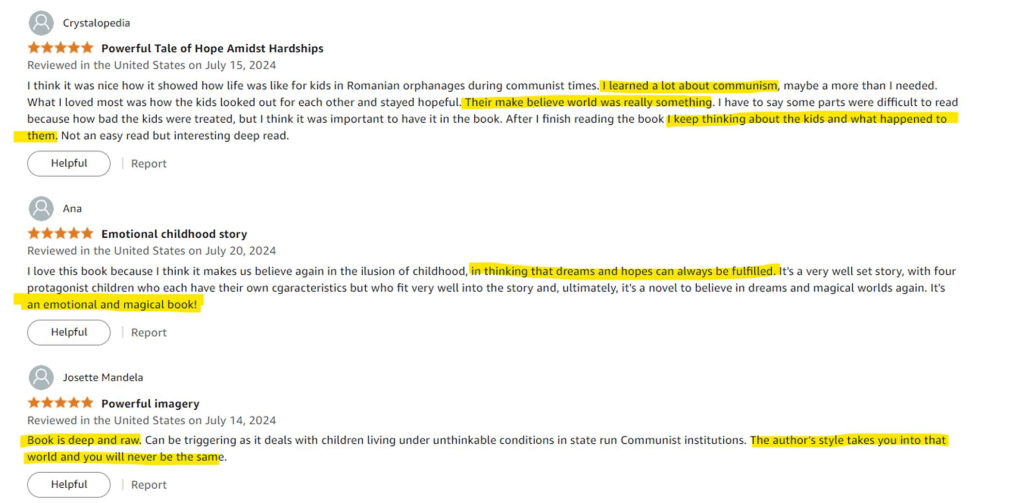
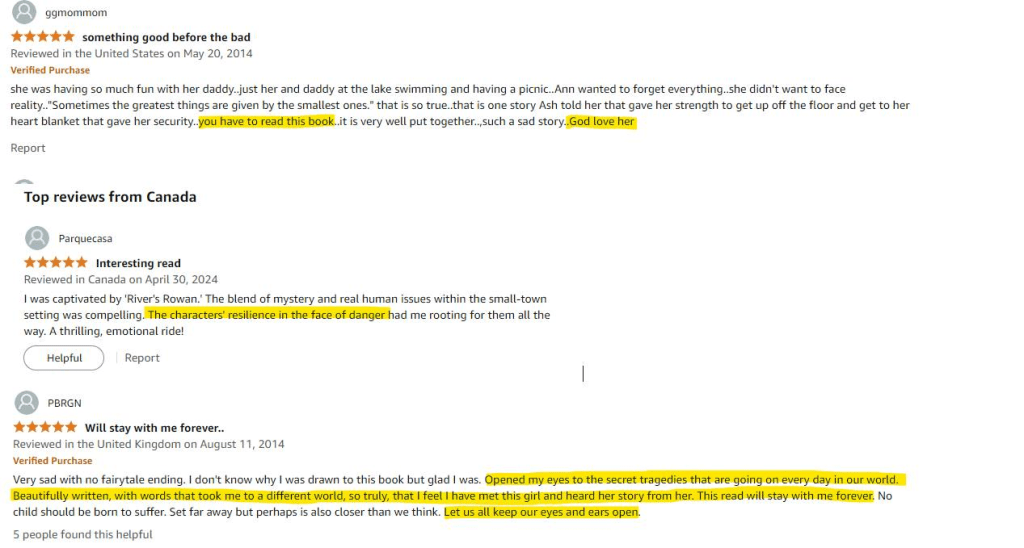
This really, really, really wrecked havoc on my confidence and on me. Frankly, it made me panic. If I cannot write, I cannot heal. If I cannot write, I cannot share, and if I cannot share then I am alienated, truly alone. If I cannot volunteer and help people, then I cannot transform something painful into something positive, and it is harder to believe I am not alone. So, I turned to the reviews and e-mails I’ve received from my “Storytimers.” If you count Goodreads, Amazon, Amazon.ca, and all the other venues, there are more than 2,000 reviews and more than half of those are 5-star. That’s more than the 5 needed to combat the 1 negative. I’m not doing this to say “look at me,” (it’s taken me years — too many years — to accumulate these reviews; it’s not that impressive); I’m doing this to show how I try to heal, and to show how much these readers matter to me.
The photos on this post are a few of these reviews, and I’ve highlighted the parts that struck a chord with me. Listen, I put my characters where I’ve been. There is real-life in every single one. On top of these, I’ve got e-mails from survivors from RAINN telling me that listening to my speech encouraged them to tell someone they trust. One email about “The Character” said, “Tiffini, perhaps I’m being presumptuous, but this is a classic and striking example of art as redemption. It is a reverberating ‘I survived and shined!’ and has rocked me to the core.” Another email, also about “The Character,” said, “This book helped me understand someone close to me.” I can’t read these and say that God isn’t working. I’m not the one making a difference, I can’t do change lives… but He can. Maybe the stories, maybe the 17,000 hours on the hotline, maybe the workshops and the speeches …. Maybe I’ve been one of the “counter” voices for someone else, and who’s to say that my voice wasn’t one of enough to eradicate a shouting lie?

Reading these readers’ reviews and the e-mails from survivors right now helps me feel like I have permission to write. There are 2,000 reviews and, sitting in my “Storytimers” folder of my inbox, an additional 223 e-mails from the last three years alone that I can lean on.
Another One
The other, equally damaging thought I was trying to counter was “nobody likes you, nobody cares.”
Today, I needed to believe that wasn’t true. So, I started scrolling through old photos on my phone – I really don’t know what I was looking for. But I stumbled across a picture that was taken 3 or 4 years ago, when I was working in TN. I’d been at this place for a long time and had put my entire heart and soul into it. HR asked the managers to write, anonymously, what we thought of each other and put the positive thoughts into an envelope that they were going to distribute later. I took a picture of what people said about me because they did not match what I thought they thought. The fact that there were recurring comments – no one knew what everyone was writing and so that means they independently thought the same things about me. 11 people knew I cared about them, and thought I was kind, and I know for sure one of them genuinely cared. The shout didn’t say “almost nobody likes you, almost nobody cares.” It says, “Nobody.” These notes, my girls, and God tell me that that negative thought … it simply isn’t true. The problem with negative bias is that it’s an uphill battle. One day, I’m strong enough to do this and to hear it – another, I might not be, or the shouts might go up to a crazy high level or the fear might blow out any logical thinking. For today, though, it’s given me the ability to breathe.

Conclusion
The things that we hear, at any volume, impact us, and matter. The negative things we hear are harder to let go of because we are literally hardwired to respond to negative information faster than positive. We are also prone to keep the negative things longer. But just because something is shouted doesn’t make it true. Just because something sounds true or feels true… doesn’t mean it is. We can train ourselves to hear and see kindness and when we do, we often see that there’s more than enough to “outweigh” the negative.
And for every single “Storytimer” who has ever privately or publicly told me they read something I wrote, be it a book or a blog post, you have no idea how much your reading means to me. Writing is about so much more to me than writing. It’s about processing. It’s about sharing. It’s about connection. It’s about healing. For every teacher, doctor, friend who has ever said, “Talk to me” — ::tears up writing this:: — you are world shakers for whom I am so grateful and of whom I stand in awe.

 Tiffini Johnson