
Living with Gratitude: My Journey with Eye Injections

My eighteen-year-old grandfather, Papa, lived in the country. Cliche though it may indeed be, I heard the tales of “traveling uphill in a blizzard to school by foot” stories most of my childhood. His mother, whom we called Mama Nora, married at thirteen, was widowed a few years later, had more babies die than lived and, generally speaking, lived what many would call a “hard life.” Like most children who grew up in the middle of absolutely nowhere of West Tennessee, Papa had chores, and those included chopping down trees for firewood. When he was eighteen, he was doing just that one morning when the axe flew out of his hand, up into the air, and fell on his head. It didn’t knock him out cold, and he didn’t bleed. He shook it off and went about his day. That night, he went to bed with a headache. When he awoke, his sight was gone.
Papa could see shadows and variances between light (it was dark or day; the room’s lamp was on or off), but not much else. My sister and I grew up playing games where we would deliberately try to sneak by him without him knowing. We never won. He’d always interrupt our break-ins by going, “Who is that? Tiffini? Mandi? Which one of you is that?” Freshly armed with my driver’s license, my sixteen-year-old self would play taxi, driving him to the barber’s shop and to the post office’s lunchroom, which he and my grandmother ran. “You’re doing better, staying between the lines.” I always wondered, How do you know that? You cannot SEE, Papa. He walked with a white cane with a red tip, could read braille and loved listening to the trucker’s radio and Western audio books. He was a loud alcoholic and you could never know for sure what was going to come out of his mouth: the first (and only) man I brought to meet him was subjected to some pretty outlandish comments and questions.
Papa was what you think of when you think of a domineering patriarch. His word was law. But, underneath that brash exterior was a man we believed genuinely loved us. He brought blank tapes and told me to record some of my books so that he could listen to them. He knew the man who wrote Walking Tall, and he gave my manuscript to him, trying to “figure out if you’re really good.” At my very first book signing, even though I was estranged from my entire family, I wanted Papa to know I was having a signing, so I sent him an invitation even though I knew he wouldn’t come. He didn’t come, but he sent my grandmother instead to buy a book. Papa was flawed. He had terrible, grievous mistakes — he talked judges into being lenient when my fourteen-year-old father was arrested for threatening to rape a teacher and her daughter, he deliberately hurt some members of our family, he made offensive comments all the time and on purpose. But I never felt truly unsafe around Papa. I would sleep in the chair beside him and Grandmama, I would make him sandwiches before he asked, and I genuinely looked forward to seeing him. Papa was what you’d call a big personality, and I loved him.
Some time ago, I was told that there was a chance my vision in my right eye would be lost. “Probably not for several years,” I was told. “Right now, it’s stable; we’ll just monitor it for now,” they said. “When it does start to worsen, there’s medication to keep it stable,” they promised. This was devastating. I was fiercely independent: I love to drive because it represents freedom. I couldn’t imagine the thought of not seeing my daughters or of needing accommodations. I was driving home one day, shortly after an appointment where I was told it was getting a little worse, and the thought came through my mind, “Papa was blind.”
The thought reassured me immensely because Papa was larger than life. Papa was unquestionably head of the house. He controlled what happened. He always knew when me or my sister were trying to sneak past him. He knew when I learned to drive straight. My sister was a toddler and having terrible seizures: he drove my mom to multiple hospitals until they reached Vanderbilt and a cure. When my father up and disappeared on us, leaving us stranded in Florida, he made a friend drive him down to pick us up. They paid our rent more than once and let us live with them when no one else would. Papa walked with a cane, but he was as independent as they came. He worked by managing the post office lunchroom (which meant he sat in the office and ran the cash register when employees came to buy candy. I used to wonder how he knew what bills to return to them). Papa was blind in both eyes: only my right was at risk and, they said, I had years before losing it. So, the thought of Papa comforted me.
Since that day, when I thought to myself, “it’s just my right eye. Papa was blind in both,” my eye has gotten worse. To the point where the macular degeneration affects my vision. Floaters are common, and it sometimes looks like there’s a thin sheet over my eye. I can still see, but it’s not as clear as it’s supposed to be. I invested in ridiculously expensive glasses called Neurolenses with prisms to help. But, recently, I was told that it was time to start injections.
So, last month, I had my first injection. Yesterday was my second. They were very different experiences, so I thought I’d record them. For one, it’ll help me remember and be able to say, sometime down the road, “and I thought that was hard,” cause what’s hard today usually doesn’t seem so monumentally hard with hindsight.
We chose to go with Eylea. What happens is that abnormal blood vessels start to leak. The fluid can get into your line of vision and prevent you from seeing. The medication stops the growth of the abnormal blood vessels, and this means it stops the leakage. Over time, your body will naturally absorb the fluid that’s there, and it results in clearer vision. Usually takes about three treatments to notice a difference and treatments are every 4 to 5 weeks. As long as you take your injections, chances are, you can delay the deterioration of vision for quite some time.
Eylea is not the only anti-VEGF injection: there are others, such as Avastin. Both offer similar results, but Avastin has a slightly increased chance of infection compared to Eylea. Eylea is more expensive. I have wet macular degeneration, which typically spreads faster than dry macular degeneration. Eylea HD (as opposed to just Eylea) is new but studies have shown that it can help patients space out treatments longer than Avastin. So, we chose Eylea because of the decreased risk of infection and because it might be easier to get insurance to eventually approve Eylea HD so that instead of having to receive an injection 6-12 times a year, I might only have to do it 3-4 times.
While everyone’s copay is different based on your insurance, I pay $130 copay each time for the injection. Right now, that means my out-of-pocket expense is somewhere between $1,300 and $1,500 a year for this injection depending on how often I need it. Right now, I’ve not had to do this for a full year yet, so I don’t know which it will be. Next year, I will budget for it by taking out the max I can from an HSA account through my employer so that the funds are available when I need them. Also, to help with the cost, Eylea does have a card that helps patients afford it. You’re offered it automatically when your provider orders the medication. I’m saying all this because there are ways to make Eylea affordable.
So, what’s it like?
First, you have a regular eye appointment. I was dilated. Because the injections can increase the pressure on your eye, they will check and monitor the pressure of your eyes to make sure it’s safe to give you the injection. Then, they’ll find a vein and inject dye that will tell them, in color, whether or not there is leakage (fluid: they are looking for fluid). This was not fun for me. I have terrible veins, awful. When I got a port put in, they had to give me a mid-line just to do the surgery to get the port. So, finding a vein is like finding a needle in a haystack. I promise, they’re there, but they just disappear all the time. The dye is bright yellow – neon yellow — and stained my hand. It can also make your urine look like yellow paint. Both are normal.
Once the tests are completed, you’ll see the provider, who will show you the images and explain all the science. Basically, they’ll say “you need an injection” or “you’re okay right now, come back in three weeks.” Last month was my first injection, so this part took a little longer because I had more questions. Once the exam is finished, the assistant will give you numbing drops. One drop, then five minutes later, another drop. Five minutes after that, she’ll give you the deep numbing lidocaine. It’s a shot into your eyeball. She’ll tell you to look down and away while she holds your lid up and injects the lidocaine. This did not hurt at all because of the numbing drops I already had. They know it works because they’ll see a bubble come up under the eye. If they don’t, like they didn’t on my second visit, and you or the nurse is questioning whether or not you’re truly numbed, they can give you a lidocaine gel to make certain.
After the lidocaine, you’ll sit for about five to ten minutes to let the lidocaine make good and sure you are numb. At this point, the doctor comes back in. She’ll come up, say, “you ready?” and then tell you to look down and away from her.
This is where my experiences were vastly different from one another.
When I received the first injection, I was very scared. Very scared. I didn’t know what to expect and no one had warned me that I might experience what’s called a “white-out.” A white-out is because there’s enough fluid still in your eye to maintain its shape. When additional fluid (the medication) is put into your eye, your eye swells and changes shape briefly. This results in total white out of vision. But only for a few minutes until the fluid spreads and is absorbed and the shape shrinks back to normal. As it does, vision returns. I didn’t know any of that. So, as the medication was given, my vision didn’t go white – it went black, totally black. And then I started seeing lots of bubbles and, in my center vision, was a white ring. That white ring started expanding and the black started shrinking. Eventually, the solid white filled my vision and started to turn clear. As it turned clear, I saw tons of bubbles. It looked like I was under water with my eyes open. I could feel the bubbles moving in my eye.
I was royally freaked out. The nurse calmed my fears, assured me it was normal, and to give it a minute. Soon, I could see-ish. I was looking through bubbles, but I could see. They gave me a prescription for Polymyxin eye drops to prevent infection. I was told to use those eye drops three times a day for three days, and I was allowed to go.
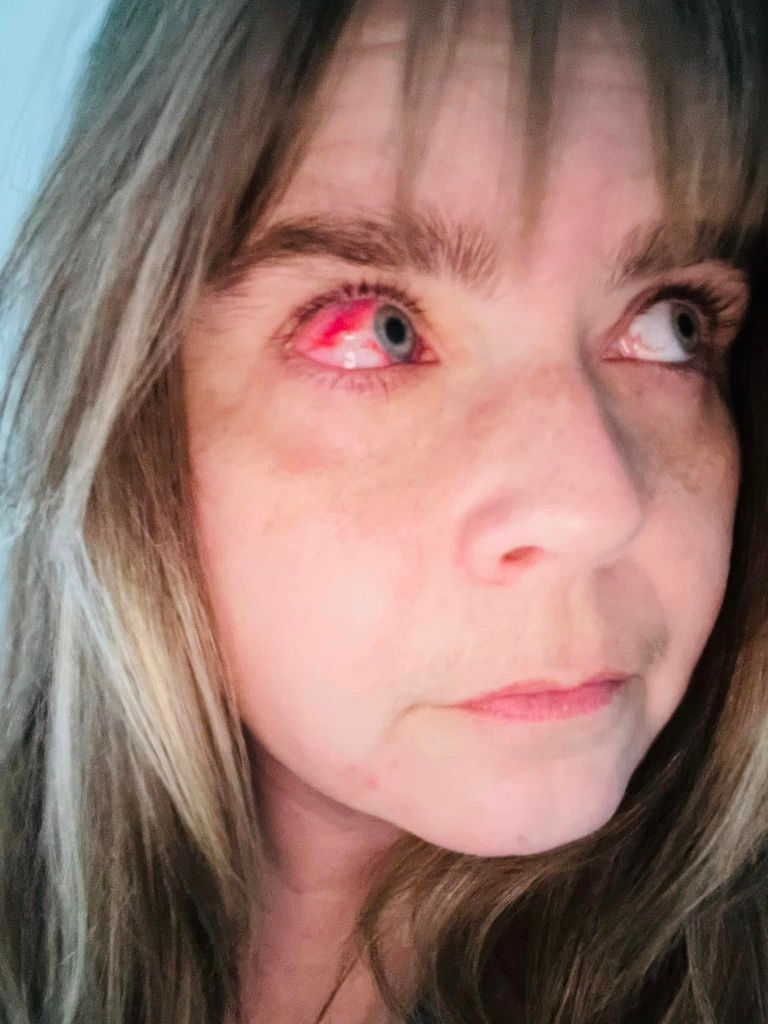
I don’t recommend doing this, but I drove home dilated and with a swimming eye. Very, very slowly and carefully. Sometimes, I found it helped to squint my right closed. Over the next two days, my eye turned blood red. This is because a blood vessel popped during the injection. Bloody eyes are normal. Scary-looking, but normal. It took about three days for the bubbles to go away completely and for me to feel like my sight was what it had been. This first experience was hard.
Yesterday, all of the details above were the same, except what happened during the injection. This time, the doctor gave the shot much higher up on the eyeball, under my lid. I felt more pressure this time. It didn’t hurt, but I did feel pressure and, even today, my eye feels … bruised a little, sore. My vision didn’t turn black this time, but I did have a true “white-out” where the vision went completely white. While it did start to get better within a few minutes, it wasn’t really good until I got home, about an hour later. I didn’t see the swimming bubbles, and my eye hasn’t turned bloody (which means a blood vessel didn’t burst this time). My vision seems clear today. My eye itself feels sore and sometimes it feels like there’s pin pricking it where the injection was given but, overall, this was a much easier injection experience. My next injection is scheduled for November 22.
Currently, I receive iron every three months intravenously to manage acute anemia. I now receive the Eylea injections as well every five weeks. As I drove home yesterday, thinking about these things, and about Papa, I couldn’t help but also think about how fortunate I am. I’ve never walked in a blizzard to school, uphill, both ways. No one has ever asked me to chop down a tree. I have the insurance and the security that allows me to get the iron treatments and the Eylea injections: there are millions who would call that very privileged. And, even when, eventually, the injections stop working as effectively as they are now and my sight starts to dim, it will only happen in my right eye. I’ll still be able to see my daughters. I’ll still be able to independently work. I’ll still be able to write. I’ll still be able to go on adventures. There are millions who can’t.
Living with gratitude and never taking a moment for granted because we don’t know what’s coming tomorrow allows me to ensure I’m seeing any obstacles as curves in a road, not a dead end. Challenges are the mirror by which I have always seen hope. If the Holocaust survivor can overcome Auschwitz, then I can smile while being given an injection in the eyeball. If a woman who longs for a baby has to instead bury a stillborn, then I, with my two beautiful daughters, will not complain about needing iron infusions every three months. If there’s a teenage boy right now so bullied that he thinks suicide is the only way out but decides he’ll reach out to a hotline “just to see what happens,” well, then I’m not going to lose a minute of life to wishing things were different for me. If the little girl raped tonight takes a shower but still doesn’t feel clean, and has no one to tell, my prayers to God tonight will be of thanksgiving that my own girls are safe.

There are so many pieces to losing sight. I hope mine will still be functional fifteen years from now but I don’t have to wait and see. I have this moment to live, this time to share conversations with my daughters, this day to notice the rainbow after a devastating hurricane. Fear has been a constant companion – I’ve never known any prolonged period of time without it, and I’d be lying if I said I don’t fear what it might be like living with diminished sight in my right eye. But fear can either be a paralyzer or a motivator. For me, I choose motivator.
 Tiffini Johnson
beautiful to find gratitude!
Thank you!