
The Evolution of a Dream

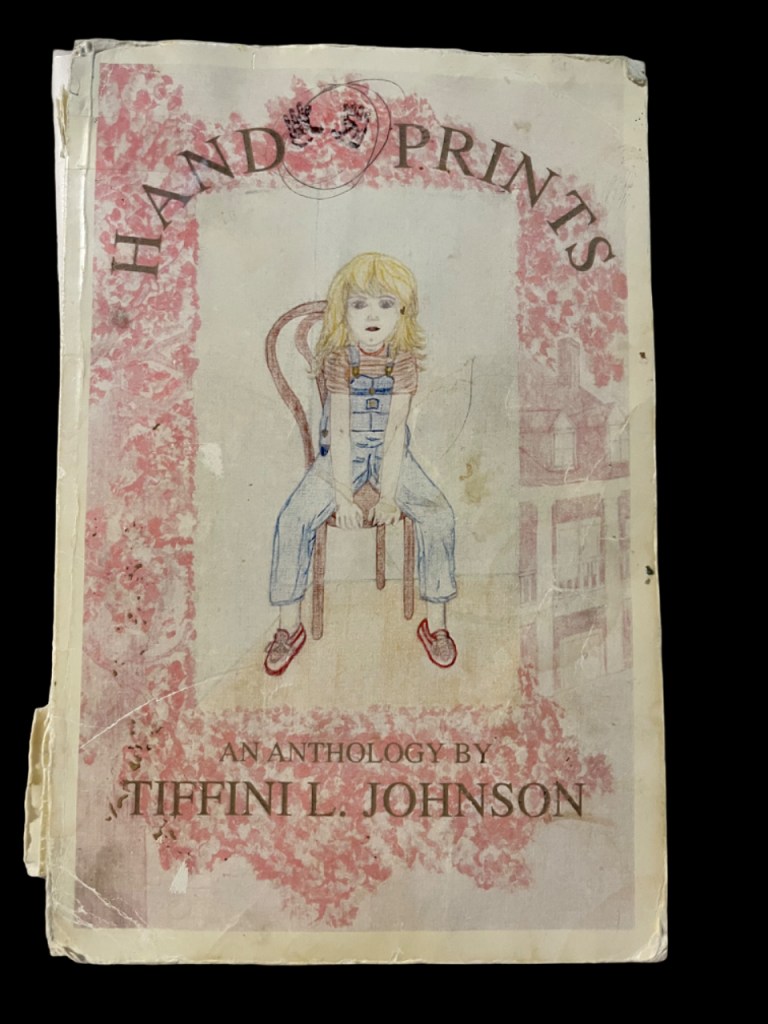
Dreams are the things that nurture the childlike spirit within us; they feed our inner joy, act as a guiding force when the monotony of life threatens to consume us, and create a contagious passion capable of transforming lives. I am a staunch defender of dreams because I am proof they come true. A group of people who are using “Ash” for a book club invited me to kickstart the club. In two days, I’m going to pop in, do a reading, and say hi. It’s going to be great, and I’m highly looking forward to it. To prep for this, I thought I’d put some goodies in with the Discussion Booklets (see below) like my business card and some bookmarks. As I was pulling these out, I found the copy of “Handprints” that I had bound way back in 2000.

Remember where I was in 2000. I was nineteen years old, attending college. I had told no one my story. Nobody knew about my dad: he’d been imprisoned for three years by this point, which was half of his sentence. I was attending synagogue regularly because it made me feel comforted. I was head over heels for the guy I was dating, I was volunteering for the Rape and Sexual Abuse Center without being anywhere near ready, and I was still making bruises on myself. I was writing stories like “Me” and “Orphan Train”, and I don’t even remember what all else. I was playing with poetry, which was the only period in my life where I did, and I was knee deep in leaning on the Holocaust to help me “be okay.” I wasn’t being open in my books, I didn’t write graphic scenes like those found in most of my books today because I was very, very scared. While I was writing up a storm with no slowing down,I wouldn’t publish one for another nine years.
Except for “Handprints.” This was a chance to have the book bound by a very small printing press, Watermark out of MD. There were limits to page count and I had zero help: no editor, no marketing, no nothing, and I had to pay for the printing. I started writing when I was around five, was telling stories to my sister at bedtime by around age eight, and by the time I was in fourth grade, teachers were letting me read my books out loud to the class during circle time (thank you Mrs. Krutsinger [4th grade] and Mrs. Haymer [6th grade]). Somewhere in there, I started practicing my autograph, and sending my mother to meet with publishers while I went to school. The idea of people I did not know choosing to read something I wrote… that was, like, bigger than the Olympics to me. I didn’t know how to dream any bigger than thinking that one day, when I grew up, I might write something that someone else wanted to read.

For this printing of “Handprints,” I worked really hard. Designed and drew and agonized over the cover: I really wanted the “faded image” of the house and I didn’t know how to do that, so I asked my mom for help. She’d been the one to strategize with me over plot twists and characters names since I was barely walking, and she helped me figure out a way to get the cover picture the way I wanted. I loved rubber stamps at this stage in my life, so I used stamps to create the pink leaves and the handprints at the top. I worried endlessly over getting the title to curve just right.Bottom line:it was my dream atthe time.I didn’t really believe I’d ever be chosen by a big house; I’d already spent a couple years sending briefs, proposals and queries to both houses and agents. Not a single one accepted. When I proudly showed it to a family member, the response I received was “It was self-published, right?Like, it wasn’t a real publisher?” I didn’t care:I didn’t stop writing. This bound copy of “Handprints” is pretty cringe-worthy. But it holds excerpts of “Mountains of Hope”, of “Cherokee Highway,” (which I’ve always wanted to type up), of “Me”, of short stories I’d written along the way like “Colors” and ”Handprints” and a collection of poetry. When this book arrived in the mail, and I opened it, I cried.I thought that was the pinnacle of my dream.
And time moved on. Three years passed and that nineteen year old was now 22, and pregnant with her first daughter. The dad who was imprisoned three years earlier was now on the brink of being released. If he were released, he would come home; if he came home, my daughter would grow up knowing him. I knew–I mean, I really knew— what he was capable of, and I knew that, if he were home, I couldn’t protect her. So, I told my mother what happened. For the first time, I didn’t have to hold back in my writing. There were no secrets anymore, so I was free. My writing slowly started changing. While it did, things happened that gave me confidence: my church had a bookstore and they bought copies of “Mountains of Hope” to sell. They let me have a signing after church. This was my first real book signing. In 2009, I had an idea for what I thought was a short story because it was in first person. I did not know the plot, I didn’t even know who the main character was. The character I saw in my head was a man, but the voice was of a ten year old little girl. Scenes kept coming to me that were nothing like the other stories and, also, they were not in order: there was no outline, it was in first person narration when I never wrote in first person (indeed had, for years, claimed I didn’t know how) and, most importantly, some of the scenes were straight up true memories. But it had this amazing character. He was… he stole my heart, and he helped me show others how I had survived years and years of rape. I spent hours taking hundreds of pictures getting the blue Bic ink pen that was much a part of me lined up just so to make it line up with the spine and choosing which pages to photograph. This cover, out of all of my books, remains the most meaningful and special to me. So much so that when, later, a publisher approached me and talked me into trusting him with the e-book version, I stipulated that there was not to be another cover. By 2013,“The Character” had made waves. More signings popped up out of the blue, people I did not know started e-mailing me for the first time ever saying, “This book was my life.”Leaning into the freedom I felt to tell my story, I took speaking engagements from Ohio and Memphis and a couple other places: a couple random here and there. I went to a conference where I got to read, had signings with other authors that intimidated me to no end. I finally got to sign an autograph for real. A real bookstore, Parnassus Books in Nashville, bought a case of my books and paid me real money for it and I was convinced THAT was the pinnacle of my dream.If asked, I’d have proudly and happily showed you the check.I did not know what else to dream for in regards to my writing. The five year old writing stories about what to get her mother for her birthday, the ten year old trying to copy the style of Ann M. Martin’s “The Baby-Sitter’s Club” series, the hurting fourteen year old writing about teenagers being held hostage in Iraq and putting characters inside Auschwitz had people she did not know reading her books. Dreams were tangibly real. And I thought that was it.

More years passed, and I kept writing. I put zero dollars into marketing (well, not exactly true: I might have spent less than fifty on bookmarks and signs for events), didn’t send a single query to a single house or agent, and did what I’d always done: I wrote when there was a character shadowing me. I wrote because it’s a God-given passion. I’m not very talented, and I am well-aware that there are others who far surpass me in both originality and technical skill. But I was telling my story, and I was staying true to who I was. For some writing is a form of entertainment, which is a good thing because, otherwise, I’d have missed out on Judith McNaught, Danielle Steel or Elizabeth Lowell and of those magnificent fairy tales. For me, writing is purposeful. It is my way of coping: when I am hurting and I can’t talk about it, I will write it in a story, when I want something too scary to name, I’ll write it. I don’t edit it for any particular audience and I assume that the only one who will read it is me. Still… I started speaking at events more, doing more book signings, gave away more books than I sold (still do that, frankly) and, somehow, magic happened: I still got checks from sales every month, reviews started coming in from various outlets, an amazing epublisher did an audio book for Dance For Me, and more people e-mailed me that I did not know. I learned how to format the interior of a book, became more deliberate about chapter headings, section breaks and invested in a dedicated platform for writing, LivingWriter. I bought Canva and started playing with cover designs that meant something to the story but also looked more professional. My writing both stayed the same and changed. It stayed the same because I still wrote for me, and only if I had a character shadowing my every move. The topics covered things I needed help processing—my father was diagnosed as a bipolar sociopath and, for years, I didn’t want to admit that because I thought it justified what happened. When this was really hurting me, I wrote The Storyteller where Daphne’s abuser is a schizophrenic. It allowed me to address and answer that question, does mental illness justify rape? That book was also significant because it was the first time a female character actually fought back and when Cole described her as a “hero,” something happened to my heart. In Taramul Vieselor, I was fighting demons, and feeling pretty selfish. So, I created a character, Alina, who is blind, raped and wants freedom more than she wants anything else. In River’s Rowan, another personal demon: I was told it takes two to tango. In other words, it was my fault because I didn’t say anything, I didn’t tell when I could have. So, was I to blame? By creating a villain who was also hurting and protagonists who weren’t altogether innocent, I was able to explore that question, does anything justify abuse? Haven was the most personal I’ve written, with the exception maybe of “Broken” and “The Character”, because it talked about “the little girl” I see in my head and that has been the underlying source for many of my decisions. My point is: my writing stayed the same in that it was still healing. It was changing, though, too because I started incorporating it into the speaking events I was doing for RAINN and other places. I organically started pairing my true story with my books because my writing helped catapult my healing and I passionately believed that the same could be true for others. Recently, I said, “who wants to do a virtual book club with me? Vote for the book you’d like to read, I’ll give it to you for free, I’ll post questions and, voila, we’ll have our book club! I didn’t think anyone would sign up, but, in less than a week, I’ve got 67 participants (but really, vote!). I have 4 events in the month of January alone. I’ve taught myself how to do book trailers (and here), and I recently received an e-mail from someone who told me I’d “changed her life.” I’ve never been on the NYT Best-seller’s List (but Amazon!), but I’m pretty sure THIS is the pinnacle of the dream.

Success is not the number of books I sell. It’s not even about selling a book. Success, to me, is about reaching people. See, the dream I didn’t know to dream was that writing might expose lies I’d believed all my life, particularly the one that sometimes whispered and sometimes screamed that I was alone and crazy. I am living proof that dreams are not fairy tales: they are reality. No, I’m not on that NYT list–I probably never will be– but if that was a dream that I decided to really go for, nothing will ever convince me it couldn’t be so. I have not done anything special: I haven’t spent a ton of money on writing; I probably don’t write the way “the real writers do” in terms of outlines or hours spent writing or anything else because I write my way (unnecessary commas included!); I don’t have more talent than anyone else. All I’ve done is write and walk through the doors as they’ve opened. Some might argue I could have a greater audience if I spent money on marketing or if I really “tried” to get an agent or a house behind me. Some might say my dream never came true because of profits earned or who knows what else. But did you know that the original meaning of the word “dream” was from the Old English word draugm which means “joy,” “mirth,” “revelry”? So to decide if a dream has come true, the true test is does it give you joy? For the last thirty-five years, that answer has been a resounding yes. Today, it is even more so with the connections it is allowing me to form with others and the way it’s pushing me to grow in my own healing. A dream is a passion that you can’t imagine life without; it’s the thing that you seek when you are hurting, the avenue with which to express your excitement when life is well, and it exists within each of us. No matter who you are, you have a way out. I so believe this that I will shout it for the next forty years. I was lucky: I learned what mine was, and how to rely on it, as a child, but anyone can discover their something because when God created mankind in His own image, He did not leave anyone out. Finding “Handprints” tonight, and putting it beside “River’s Rowan” was a physical, tangible reminder of just how far I’ve come from that five year old writing simple stories to the nineteen-year-old giddy about a bound book to the woman realizing that the dream was bigger than a book being bound. Twenty-four years after binding “Handprints,” I’m starting a book where the main topic is forgiveness and that subject is one I’ve never even contemplated tackling. See, the truth is: dreams are the representation of joy. Joy is ever possible, ever changing, and ever growing as we find out who we are. Those two things being true, dreams are not then about reaching some perceived summit but, rather, delighting in the journey as you await tomorrow’s dream come true.
 Tiffini Johnson